What Is a PM Motor in a Rotary Screw Compressor and Why Can It Be More Energy-Efficient?
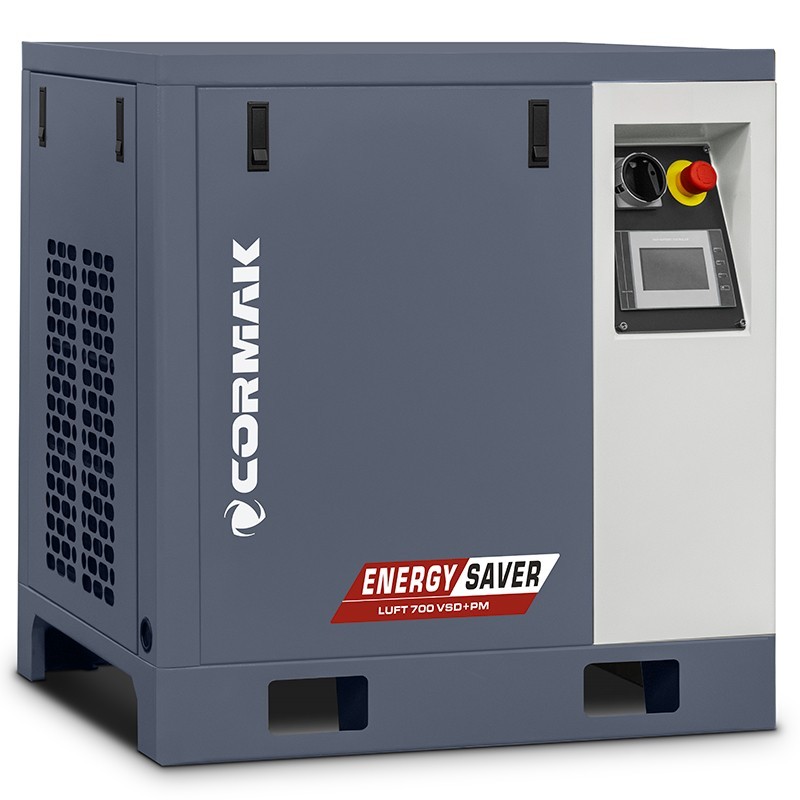
What Is a PM Motor in a Rotary Screw Compressor and Why Can It Be More Energy-Efficient?
Compressed air is a core utility in many industrial facilities. Because compressor electricity use can materially affect operating costs, more companies are considering rotary screw compressors with permanent-magnet (PM) motors, especially where air demand changes during the day.
A PM motor can support energy efficiency, but it is not a stand-alone guarantee of savings. The outcome also depends on the airend, variable-speed control, real demand profile, operating pressure, leakage level and correct compressor sizing.
What Is a PM Motor?
PM means Permanent Magnet. In a PM motor, the rotor magnetic field is produced by permanent magnets rather than by currents induced in a rotor cage, as in a typical induction motor. Reducing rotor losses can improve drive efficiency.
In screw compressors, PM motors are commonly combined with electronic control. This enables accurate speed and torque control, which can be valuable when the compressor operates away from full load.
Not every PM motor has the same construction or performance. Compare complete compressor data rather than the motor type alone.
How Does a PM Motor Work in a Rotary Screw Compressor?
In a rotary screw compressor, the motor drives the airend. Two rotors turn relative to one another, progressively reducing the volume of trapped intake air and increasing its pressure. The compressed air then flows to the receiver, air-treatment equipment or distribution system.
The PM motor supplies torque to the airend. Depending on the compressor design, the drive may be direct-coupled or use a transmission. A direct-drive arrangement can reduce some mechanical transmission losses, but it is not a feature of every PM compressor.
For the user, three values are critical: air delivered at the required pressure, power input and stable behaviour as demand changes.
Where Can Energy Savings Come From?
A PM motor can offer high efficiency across a broad operating range. That means more electrical energy can be converted into useful shaft power and less can be lost as motor heat.
The operating profile of the entire system is still decisive. In many plants, air use varies between start-up, production cycles, breaks and intermittent tool use. A compressor that can reduce speed rather than spend long periods running unloaded or throttled can align air production more closely with demand.
- lower losses in the drive;
- better energy use at partial load;
- less non-productive running when demand falls;
- more stable pressure control;
- closer matching of output to variable air demand.
Energy savings should not be assessed from a single advertised figure. Compare whole-system energy use under real operating conditions.
PM Motor and VFD: When Does the Combination Make Sense?
A variable-frequency drive (VFD) adjusts motor speed. In a screw compressor, this changes airend speed and therefore the amount of air delivered.
The PM-and-VFD combination can be particularly useful where:
- compressed-air demand varies clearly during a shift;
- the system has short demand peaks but does not require full output continuously;
- stable pressure is important;
- the company wants to reduce long periods of low-load running;
- leaks, pressure losses and pipe sizing have been checked.
Not every installation needs a single variable-speed compressor. In larger compressor rooms, a variable-speed unit may cover the variable portion of demand while fixed-speed units supply the stable base load. This arrangement should be based on measured air demand.
PM Motor vs Induction Motor
| Criterion | PM motor | Induction motor |
|---|---|---|
| Rotor magnetic field | Permanent magnets | Electromagnetic induction in the rotor |
| Rotor losses | Can be lower | Losses associated with rotor currents occur |
| Variable-speed operation | Commonly used with dedicated electronic control | Possible with a VFD, depending on motor and application |
| Part-load efficiency | May be favourable in a correctly selected system | Depends on motor design and control |
| Most important buying criterion | Compressor efficiency and fit with the demand profile | Compressor efficiency and fit with the demand profile |
Induction motors remain a proven choice in many industrial compressors. The decision should be based on the complete package and on how the compressed-air system actually operates.
How to Select a PM Screw Compressor
1. Measure or estimate air demand
Consider all consumers, their simultaneity, operating time and demand variation. For larger systems, flow and pressure measurements over a representative period provide the strongest basis for selection.
2. Compare delivered air at the required pressure
Do not compare units by displacement or motor power alone. Check delivered flow at the required working pressure and compare power input at relevant operating points.
3. Assess the load profile
Where demand is almost constant, a fixed-speed compressor may be appropriate. Where demand varies substantially, a PM motor with VFD may use energy more effectively when correctly sized.
4. Check the distribution system
Leaks, excessive pressure setpoints, blocked filters, undersized pipes and inadequate air treatment can add cost regardless of motor type.
5. Consider service and site conditions
Check maintenance intervals, consumable availability, compressor-room ventilation, manufacturer-stated sound data and monitoring capabilities.
Purchase Price and Total Cost of Ownership
A PM screw compressor with variable-speed control may cost more initially than a simpler fixed-speed model. Compare the total cost of ownership, including electricity, maintenance, consumables, downtime, air quality and expected annual running hours.
Financial value depends on operating hours, energy price, demand variability and proper equipment selection. Any payback calculation should be made for the actual installation using measurable assumptions.
FAQ
What does PM mean in a compressor motor?
PM means Permanent Magnet. The rotor uses permanent magnets to generate its magnetic field.
Does a PM screw compressor always use less electricity?
Not always. It can be highly efficient, particularly with a VFD and variable air demand, but actual energy use depends on the complete compressor and distribution system.
Is a PM motor suitable for continuous duty?
That depends on the specific compressor design, duty rating and operating conditions. Follow the manufacturer’s technical data and instructions.
Is a screw compressor better than a piston compressor?
It depends on the application. Piston compressors can suit intermittent use, while rotary screw compressors are commonly used where stable supply and longer operating hours are needed.
How should compressor motor power be selected?
Power follows from required flow, pressure, compression technology and machine efficiency. Define demand first, then compare complete compressor solutions at the required duty point.
Summary
A PM motor in a screw compressor uses permanent magnets and can reduce losses in the drive. The strongest energy-saving potential appears when the whole compressor is correctly sized and its speed control matches the real compressed-air demand profile.
Before purchase, assess delivered flow, power input, operating conditions, distribution-system leakage and air-quality needs. This is the only reliable way to compare total cost of ownership and select the right solution for the facility.
Latest blog postsAll articles →