Tapping arm – when does it speed up production?
Tapping arm – when does it speed up production?
Producing a few threads per day can be done manually or with a drilling machine. The challenge appears when one workpiece contains a dozen holes and production includes tens or hundreds of parts. In such conditions, a tapping arm can significantly improve the workflow.
The machine allows the tool to be positioned quickly over the next holes, reduces operator effort and helps maintain repeatability when producing internal threads. It brings the greatest benefit when the workpiece is large, heavy or requires many identical operations.
How does a tapping arm work?
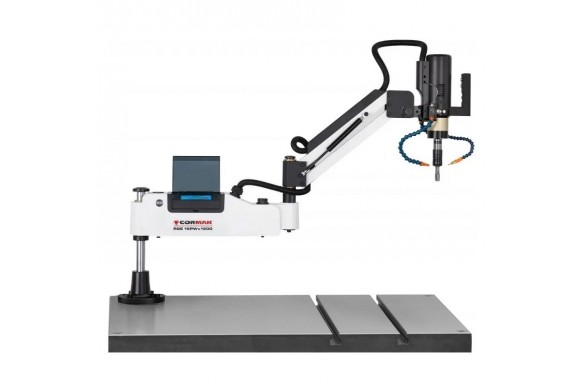
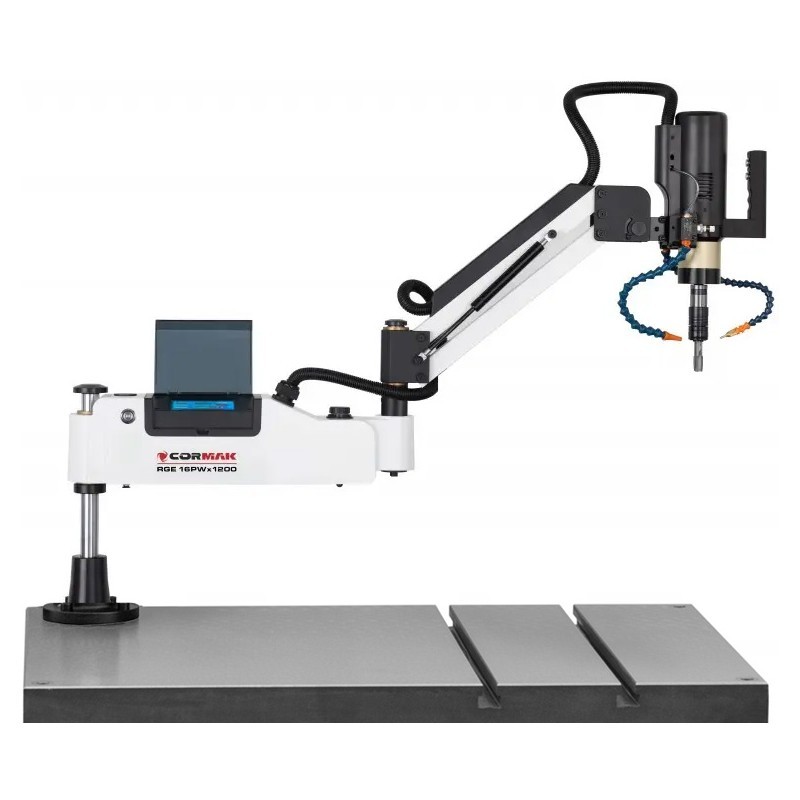
A tapping arm consists of an articulated arm and a powered head. The operator moves the head over the prepared hole, aligns the tap and starts the cycle. After the thread is formed, the rotation direction changes and the tool retracts from the hole.
The head can then be moved quickly to the next position. The workpiece remains on the table, so the operator does not need to reposition a heavy plate, frame or welded structure under the spindle each time.
An electric tapping machine can be equipped with parameter adjustment, including speed and rotation direction. This makes it easier to adapt one workstation to different thread sizes and materials.
Why does a tapping arm increase productivity?
During manual tapping, the operator has to control tool alignment, rotate the tap and keep it guided correctly. With a large number of holes, this takes time and increases the risk of mistakes.
The tapping arm takes over a large part of these repetitive actions. The operator mainly positions the head over the next hole and starts the cycle. The difference is especially visible on plates, frames and structures with many holes.
In practice, this means shorter setup time, less physical effort and easier workstation organization. If the part is large, moving the head is much more convenient than repeatedly positioning the whole workpiece under the machine spindle.
Better repeatability of internal threads
When starting a thread manually, the tap can easily be introduced at a slight angle. This may reduce thread quality, increase cutting resistance and raise the risk of tap breakage.
The arm helps keep the tool correctly positioned relative to the workpiece surface. This matters in serial production, where subsequent internal threads should have similar quality and geometry.
The solution works well for steel plates, machine bodies, aluminium parts, frames and welded structures. Repeatable tool guidance also supports quality control of finished components.
How to choose the right rotational speed?
The correct rotational speed depends mainly on tap diameter, workpiece material and tool type. Smaller threads can usually be made at higher speed, while larger diameters normally require lower speed and higher torque.
An electric tapping machine with speed control makes it easier to adapt the parameters to the task. However, the machine should not be selected only by its maximum tapping range. If a workshop mainly produces M4–M12 threads, comfortable and stable operation in that range will be the key factor.
Cooling or lubrication is also important. Proper lubrication reduces resistance, improves thread quality and may extend tap life.
Tapping arm or drilling machine?
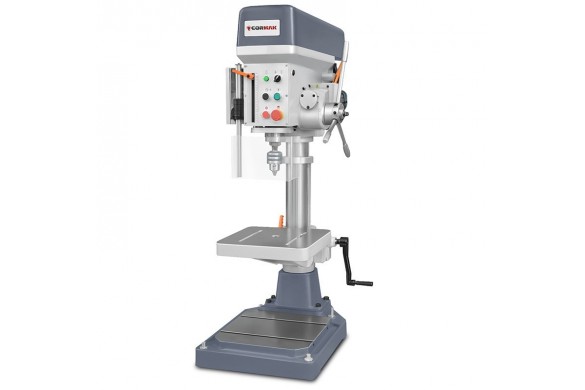
A drilling machine with a tapping function can be a good solution for smaller parts and occasional work. However, each hole must be positioned under the spindle axis, which can be time-consuming when working with a large plate or heavy structure.
A tapping arm works the other way round – the workpiece stays in place and the operator moves the head. For large parts and many holes, this can provide better ergonomics, shorter cycle time and more comfortable work.
In serial production, the difference is particularly visible. If a prepared part has a dozen or several dozen holes, moving the head quickly to the next point reduces auxiliary time and improves workstation utilization.
When is an electric tapping machine worth using?
The investment is worth considering when tapping is a regular part of production. The greatest benefits appear with:
- many threads in one workpiece,
- short and medium production batches,
- large parts that are difficult to move,
- frequent changes of thread diameter,
- the need for greater repeatability,
- reduced operator effort in serial work.
For occasional single holes, the machine may not be necessary. However, if tapping starts to limit workstation output, automation can quickly improve work organization.
Summary
A tapping arm speeds up production mainly when a large number of repeatable internal threads must be produced. It makes tool positioning easier, reduces manual guidance of the tap and improves ergonomics when working with large parts.
A modern electric tapping machine allows parameter adjustment, while the right rotational speed adapts the process to thread diameter and material type. In workshops producing batches, large plates and structures with many holes, a tapping arm can shorten working time, improve repeatability and increase operator comfort.
Latest blog postsAll articles →