Bench drill or pillar drill – what is the difference?
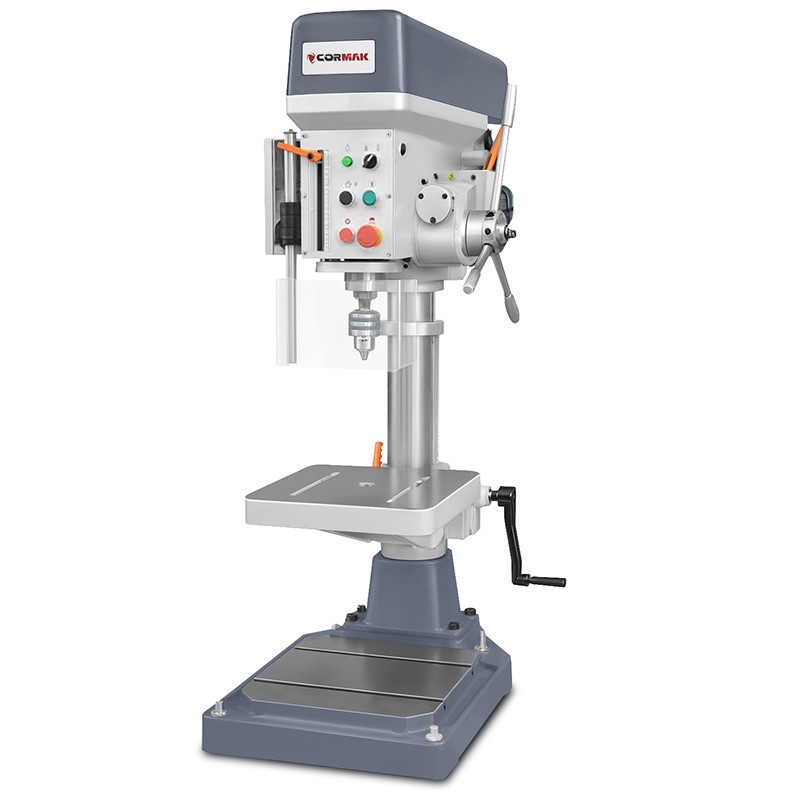
Bench drill or pillar drill – what is the difference?
A bench drill and a pillar drill operate on a similar principle, but they differ mainly in size, construction and machining capability. Both machines provide much better stability and drilling accuracy than a handheld drill, yet they are designed for different workshop conditions.
A bench drill is compact and mounted on a workbench or a dedicated stand. A pillar drill is a larger floor-standing machine. It usually offers more power, a larger working range and better capacity for heavier workpieces.
What is a bench drill?
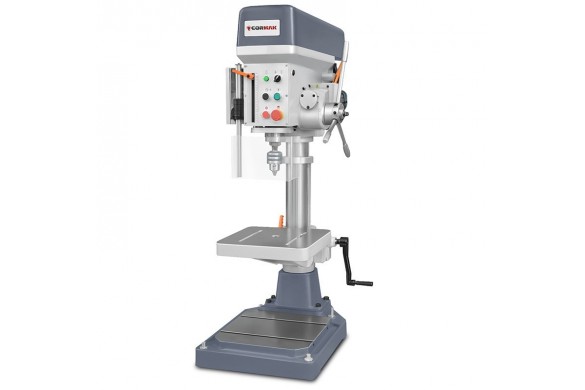
A bench drill is a compact workshop machine with a spindle, column, adjustable table and base. Because of its smaller dimensions, it can be placed on a workbench and used in service departments, small workshops, toolrooms and light production.
A bench drill is suitable for:
- drilling holes in steel and aluminium,
- machining plastics,
- drilling wood,
- countersinking,
- reaming,
- making repeatable holes in small workpieces.
Its main advantages are simple operation, low space requirement and the ability to create a stable drilling station for typical workshop tasks.
How is a pillar drill different?
A pillar drill has a long, rigid column fixed to a large floor-standing base. The worktable can be moved vertically, which makes it easier to match the working height to the workpiece and tool.
Machines of this type generally have stronger motors, larger spindles and a greater drilling range. They can also handle larger drill diameters and taller or heavier parts more conveniently.
The terminology is not always completely consistent. A bench drill can also have a column-type design. In practice, however, the term pillar drill is most often used for larger, floor-standing workshop machines.
Workpiece size
One of the most important differences is the working space. A bench drill is suitable for small flat bars, profiles, sheets, sleeves and small machine parts. Its limitations are the column height, spindle travel and the distance between the spindle and the table.
A pillar drill provides much more space. The table can be lowered to accommodate a tall workpiece and, in some cases, the part can be placed directly on the machine base. If a workshop regularly drills large structures or tall components, a pillar drill will usually be more versatile.
Power and drilling diameter
Compact bench drills are intended mainly for small and medium drilling diameters. As the drill diameter increases, the required torque, spindle rigidity and motor power also increase.
In such conditions, a pillar drill has the advantage. Its larger and heavier structure dampens vibration more effectively, which is particularly important when drilling large holes in steel.
When selecting a machine, check the maximum drilling diameter, motor power, speed range, spindle stroke and spindle taper. Only the combination of these parameters shows whether the machine is suitable for the planned work.
Stability and accuracy
Both types of drill offer more stable tool guidance than handheld equipment. A heavier pillar drill, however, provides greater rigidity during demanding machining, especially with large drill diameters and hard materials.
A bench drill can also provide good accuracy, particularly on small components. The machine must be set up securely, the workpiece must be clamped properly and an appropriate machine vise should be used.
In repeat production, reliable workpiece positioning is essential. It allows the next holes to be drilled in the same location and reduces the risk of part movement during machining.
Spindle speed adjustment
Both bench and pillar drills may offer several spindle speed ranges. In simpler machines, speed is changed by moving drive belts. More advanced models may use a gearbox or stepless VARIO speed control.
Speed selection is important because a small drill and a large drill in steel require different parameters. Smaller diameters usually need higher speeds, while larger drill bits and harder materials are machined more slowly.
The more varied the production, the more useful a wide speed range and convenient adjustment become.
When is a bench drill the best choice?
A bench drill is a good option when most workpieces are small or medium-sized. It suits workshops that need a precise drilling station for regular work but have limited space.
It can also serve as an additional production machine. For example, it can be dedicated to one repeated hole type so that a larger drill does not need to be reset or a more advanced station is not blocked.
When is a pillar drill better?
A pillar drill is more suitable for intensive work, larger parts and larger hole diameters. It is worth choosing when the workshop needs a more universal machine and wants to retain capacity for more demanding future jobs.
A larger working area, more rigid structure and stronger drive make the pillar drill a good solution for professional workshops, maintenance departments and production plants.
What should you check before buying?
When comparing models, check the maximum drilling diameter, motor power, spindle travel, throat depth and speed range.
Table size, table adjustment, spindle taper, base stability and available accessories are also important. In more advanced machines, automatic spindle feed, coolant system, tapping function and stepless speed control may be useful.
Summary
A bench drill is compact, convenient and well suited to small and medium-sized workpieces. It takes up little space and provides accurate tool guidance, making it a practical choice for typical workshop tasks.
A pillar drill offers a larger working area, a more rigid structure and usually more power. It is better for heavier parts, larger drilling diameters and more intensive production.
If the workshop mainly handles small components, a bench drill will be an economical and practical solution. If greater versatility and the ability to machine larger parts are required, a pillar drill is the better choice.
Latest blog postsAll articles →