Welding Rotator: Drive, Rollers and Controls – What Matters Most?
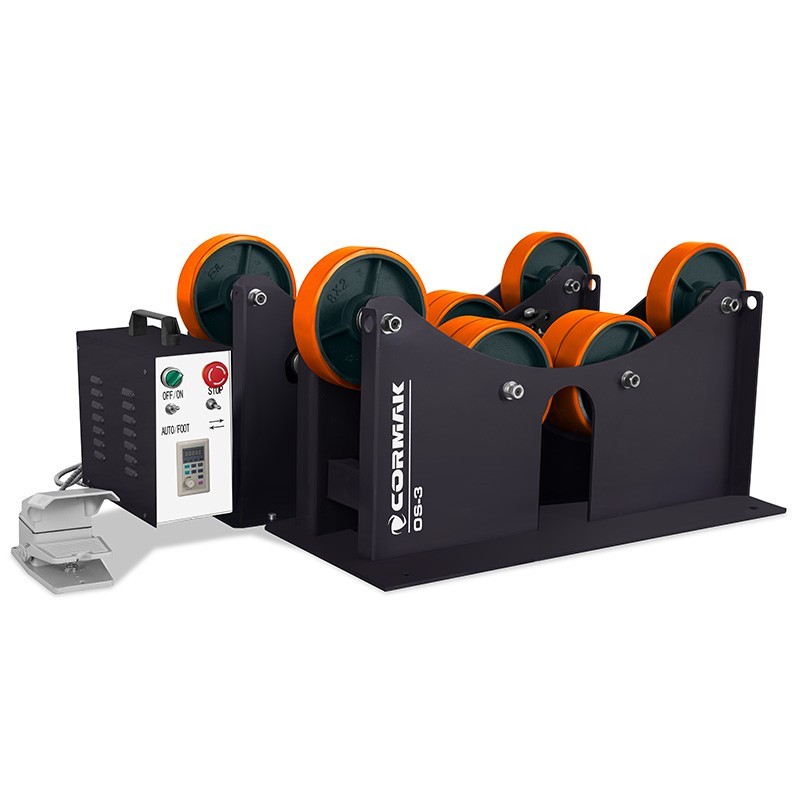
Welding Rotator: Drive, Rollers and Controls – What Matters Most?
A welding rotator provides controlled rotation of pipes, vessels, sleeves and other cylindrical workpieces. It helps maintain a convenient welding position, supports repeatability and reduces manual handling of heavy parts.
Selection should not be based on nominal capacity alone. Workpiece diameter, load distribution, centre of gravity, drive torque, roller material, low-speed stability and control ergonomics are equally important.
What Is a Welding Rotator?
A welding rotator is a device for controlled rotation of pipes, vessels, sleeves, cylinders and other approximately cylindrical workpieces. The part rests on a set of rollers while the powered section turns it. This allows the welder to keep a circumferential weld in a more consistent working position instead of repeatedly moving or turning a heavy workpiece by hand.
Rotators are used for:
- welding pipes, nozzles and sleeves;
- manufacturing tanks, shells and heat exchangers;
- circumferential welds in steel structures;
- semi-automated and robotic welding cells;
- applications in the energy, process and machinery sectors.
A rotator does not replace correct workpiece preparation, fixturing or risk assessment. Its role is to provide stable support and controlled movement during the operation.
Rotator Drive – the Key to Precision and Productivity
The drive controls rotation smoothness, maintains the required speed and supports stable operation under changing loads. Motor power alone is not enough: gear reduction, torque, speed adjustment and intended duty cycle also matter.
Electric drive
Electric drive is standard in most industrial rotators. A correctly selected motor-and-gearbox combination can maintain operation across the speed range required by the welding process.
Variable-frequency drive
A VFD provides smooth speed adjustment. It is especially useful for slow, stable rotation in precise processes such as TIG welding, and where one rotator needs to handle parts of different diameters and weights.
Servo drive
Servo drives are used in advanced cells that require accurate synchronisation with a robot or other equipment. They require proper control integration and safety measures for the complete work cell.
Key drive parameters
- speed range – matched to welding technology and workpiece geometry;
- low-speed stability – important for precise welds;
- torque – selected for weight, diameter, centre of gravity and rolling resistance;
- duty cycle – consistent with actual operating time and the manufacturer's documentation;
- overload protection – useful for protecting the drive system.
There is no universal power-reserve percentage for every application. Capacity and torque should be selected using the real load arrangement, not simply the workpiece mass.
Rotator Rollers – an Underrated Foundation of Stability
Rollers provide support, guidance and transmission of motion to the workpiece. Incorrect roller material, insufficient spacing or poor matching to part diameter may cause slip, uneven rotation and surface damage.
Steel rollers
Steel rollers are suitable for heavy-duty applications where load resistance and wear resistance are critical. Their contact with the workpiece should still be assessed where surface marking is a concern.
Polyurethane rollers
Polyurethane rollers can reduce the risk of marking the workpiece surface and provide good traction. Their selection needs to account for temperature, capacity, welding spatter and the working environment.
Rubber-coated rollers
Rubber-coated rollers provide a compromise between traction and surface protection. Check resistance to temperature, oils, coolants and other materials present at the work station.
What should be checked?
- adjustable spacing for different pipe and vessel diameters;
- capacity of the complete roller set and actual mass distribution;
- roller diameter, which affects support stability;
- traction: too little causes slip, while excessive resistance loads the drive;
- roller-surface condition, as wear and contamination reduce smooth rotation.
For painted, polished or stainless-steel parts, test the roller material on a representative workpiece before production begins.
Controls – Ergonomics and Full Process Control
The control system affects operator ease of use and the ability to control the process accurately. Good controls should be clear, accessible and suited to the actual work method.
Basic functions
- smooth speed adjustment;
- start and stop;
- rotation-direction reversal;
- clear machine-status indication;
- safety functions specified for the work cell.
Foot control
A foot pedal can help where the welder needs to manage the torch and workpiece at the same time. Its placement should be ergonomic and protected against unintended activation.
Cycle programming
For serial production, stored settings, cycle programming or communication with other equipment can be valuable. They support repeatability when programs are correctly set and verified before use.
Ergonomics
The control panel should reduce unnecessary operator movement, remain easy to read and be protected from spatter and mechanical damage.
Welding Rotators and Production Automation
In serial production, a rotator can work with a welding robot, power source, wire feeder, positioner or PLC control. This integration can support repeatable rotational parameters and synchronisation of workpiece movement with welding.
Automation can help with:
- repeatable speed and direction;
- programmed operating cycles;
- synchronisation with welding;
- better use of operator time;
- more stable quality for repeatable workpieces.
It does not eliminate the need for correct part preparation, parameter checks, maintenance and safe operating procedures.
How to Select a Rotator for Your Business
Step 1: Define workpiece parameters
Include minimum and maximum mass, diameter, length, shape, centre of gravity and surface type. For irregular workpieces, verify whether roller support alone is adequate.
Step 2: Select capacity
Compare part requirements with manufacturer documentation, considering the actual loading arrangement. Long or heavy vessels may need multiple roller sets or a powered-and-idler configuration.
Step 3: Select roller material
Match it to load, diameter, required traction and surface sensitivity. Also check the range of roller-spacing adjustment.
Step 4: Check the drive
Verify torque, speed range, low-speed stability, duty cycle, power supply and service availability. For planned automation, confirm that the controls support the required integration.
Step 5: Assess controls and safety
Decide whether manual control is sufficient or whether a foot pedal, parameter memory, external control or robot synchronisation is needed. Include guarding of moving zones and safe operating rules.
Key Rotator Elements – Comparison
| Element | What it affects | What to check before purchase |
|---|---|---|
| Drive | Smoothness, torque and rotation stability | Speed range, torque, duty cycle, VFD or servo |
| Rollers | Support, traction and surface protection | Material, diameter, spacing, capacity and surface condition |
| Controls | Ergonomics, accuracy and operational safety | Speed adjustment, direction, foot pedal, programs and integration |
| Structure | Workstation stability | Placement, workpiece setup, service access and guards |
Common Purchasing Mistakes
- choosing a unit only by catalogue capacity;
- ignoring workpiece diameter, length and centre of gravity;
- not analysing roller material and operating conditions;
- lacking smooth speed adjustment for processes needing stable rotation;
- underestimating serial-production and automation needs;
- having no service plan or access to consumable parts;
- omitting safeguards and safe operating procedures.
FAQ
Is a welding rotator necessary?
Not in every process, but when welding cylindrical workpieces it can make it much easier to maintain an ergonomic position, steady speed and repeatable weld handling.
What capacity should be selected?
Selection should account for weight, diameter, length, centre of gravity and load distribution. Use manufacturer documentation and a review of the actual application.
Is automation worth the investment?
Automation is particularly useful for repeatable series and integrated work cells. Its value depends on production volume, number of workpiece variants and the required quality level.
Which rollers are best?
There is no single solution for all cases. Steel rollers suit heavy-duty work, while polyurethane or rubber-coated rollers may help where surface protection is important. Final selection depends on load, temperature, traction and workpiece material.
Summary
Three areas are critical in a welding rotator: the drive for smooth and stable rotation, the rollers for secure workpiece support, and the controls that give the operator effective process control.
The best selection comes from analysing actual workpieces, welding technology, planned loading and automation needs. A properly selected rotator can support weld quality, ergonomics and repeatability when it is correctly implemented and safely operated.
Latest blog postsAll articles →