Welding Cobot – When Does Automation Pay Off?
Welding Cobot – When Does Automation Pay Off?
A welding cobot is a solution for companies that want to improve weld repeatability, shorten production time and reduce the workload of welders on repetitive tasks. Unlike a conventional industrial robot, a cobot is designed for easier operation, faster programming and use in smaller production spaces.
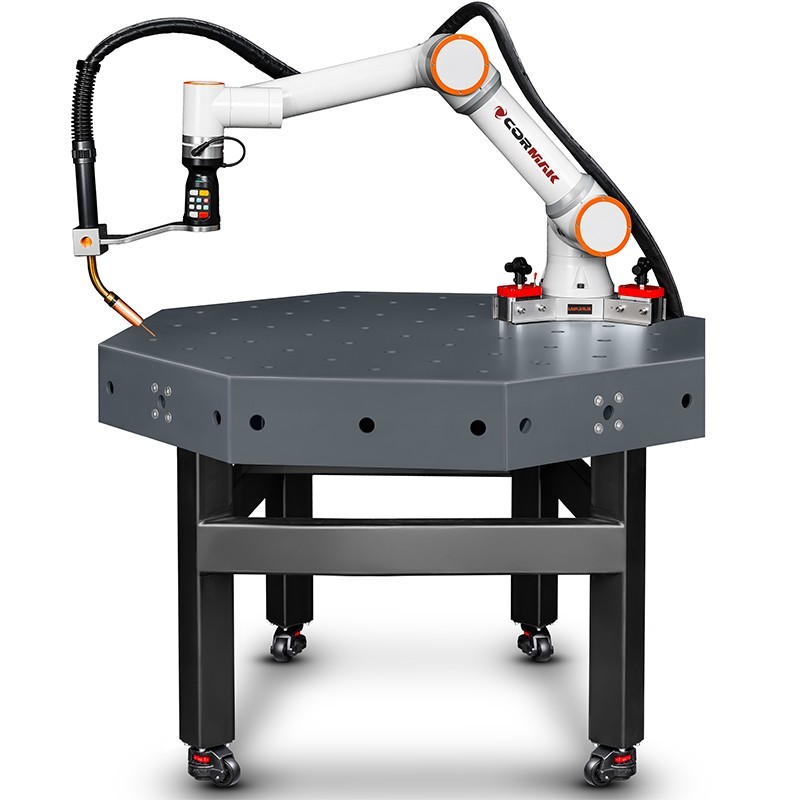
Welding automation does not always require a large robotic production line. In many workshops, a station with a cobot, welding power source, worktable and suitable fixtures is enough. This type of setup can be especially beneficial for companies that regularly manufacture similar parts but do not want to invest in a complex robotic system.
What is a welding cobot?
A cobot, or collaborative robot, is a machine that performs repeatable welding movements along a programmed path. The operator prepares the part, sets the program, starts the process and checks the final result. The cobot guides the welding torch with consistent speed, angle and distance from the material.
In welding, process stability is critical. Even an experienced welder may find it difficult to maintain identical quality for many hours. A cobot for welding repeats the same movement many times, helping to reduce differences between parts.
However, it does not completely replace people. An operator is still needed to prepare components, select parameters, set fixtures, inspect the weld and react if a problem occurs. Automation works best when machine repeatability is combined with the knowledge of a welding specialist and operator.
When does welding automation make sense?
Welding automation is most cost-effective when a company produces repeatable parts. The more often the same weld is made, the easier it is to recover the time spent on programming, station setup and fixture preparation.
A welding cobot is suitable for frames, steel structures, brackets, holders, housings, machine components, tables, racks, gates, fences and parts produced in short or medium batches. These do not have to be very large series. In many cases, repeatable jobs are enough, provided that the saved program can be quickly recalled and reused.
A cobot also makes sense where welders perform many simple, monotonous welds. Moving such tasks to a robotic station allows skilled employees to focus on more difficult operations, quality control, production preparation or work that requires manual experience.
When may a cobot not pay off?
Not every company will immediately use the full potential of a cobot. If production is highly one-off, every part is different and welds are difficult to access, implementation may be less efficient. In such conditions, programming, setup and changeover time may be longer than the welding operation itself.
A cobot will not solve problems caused by poorly prepared parts. If components have large gaps, variable dimensions, unstable clamping or poor repeatability after cutting and bending, the robot will simply repeat those errors. Robotic welding requires a well-prepared process.
Before purchasing a cobot, it is worth checking whether the company has parts suitable for automation. The best candidates are components that can be clamped securely, positioned repeatably and welded along a fixed path.
Main benefits of using a welding cobot
The key advantage is repeatability. A cobot guides the torch in the same way during every cycle. As a result, the weld can be more consistent and quality becomes easier to maintain in serial production.
The second benefit is productivity. While the cobot is welding, the operator can prepare the next parts, monitor the process or handle other tasks. In a well-organised station, this shortens production time and reduces downtime.
Ergonomics are also important. Welding long, repetitive seams can be tiring and demanding on the eyes, hands and back. A cobot takes over the most monotonous parts of the work, while the welder can focus on tasks requiring greater skill.
Automation can also reduce the impact of labour shortages. When qualified welders are hard to find, a cobot may help stabilise production and reduce dependence on manual work for repeatable components.
What should be prepared before implementation?
Fixtures are essential. The part should always be placed in the same position. A well-made welding fixture shortens setup time and helps maintain repeatability.
Welding parameters are another key factor. Current, voltage, travel speed, shielding gas, wire type and weld sequence must be selected correctly. A cobot does not replace welding technology; it performs it in a repeatable way.
The workflow should also be analysed. The station should be organised so that the operator can load and unload parts quickly. If part preparation takes too long, the cobot will wait, and the potential of automation will not be fully used.
How to evaluate welding cobot payback?
The simplest approach is to compare manual welding time with cobot cycle time, including loading, unloading, inspection and possible corrections. Important factors include the number of repeatable parts per month, weld length, changeover time and how often a given batch returns to production.
A cobot is more likely to pay off when:
- parts are repeatable and easy to fixture,
- weld paths are similar,
- batches return regularly,
- the company has difficulty finding welders,
- weld quality must remain stable,
- production needs to increase without significantly expanding the team.
Payback also improves when one operator can handle several stages of the process or prepare the next parts while the cobot is welding. That is why it is worth analysing the whole workflow, not only the time needed to make one weld.
Summary
A welding cobot pays off when a company produces repeatable welds and wants to stabilise production. It works best with series of parts that can be easily clamped and welded along a fixed path.
It is not the right solution for every process, but in a well-prepared workstation it can shorten production time, improve repeatability and relieve welders from monotonous work. The key to success is not only buying the device, but also preparing the fixtures, parts and production organisation properly.
Latest blog postsAll articles →