Magnetic drill or bench drill – which one should you choose?

Magnetic drill or bench drill – which one should you choose?
A magnetic drill and a bench drill are both used for drilling holes in metal, but they are designed for different working conditions. A magnetic drill is mobile and allows holes to be made directly in large steel structures. A bench drill, on the other hand, provides a stable workstation, broader versatility and more convenient machining of workpieces in a workshop.
For companies carrying out installation work on site, a magnetic drill can be a very useful specialist tool. However, if most operations take place in a workshop, service area or production plant, a bench drill will usually be the more practical choice. It enables accurate drilling, countersinking, reaming and, in selected models, tapping.
How does a magnetic drill work?
A magnetic drill is equipped with an electromagnetic base. Once the machine is placed on a steel component, the electromagnet clamps the base to the surface and stabilises the drill during operation. This allows the operator to make holes without moving a large workpiece to a separate drilling station.
This solution is used for steel structures, beams, profiles, tanks, frames, bridges and components that cannot be conveniently transported to the workshop. The operator positions the machine directly at the drilling point, which is a major advantage during installation and service work.
The main advantage of a magnetic drill is mobility. The machine can work on large components, including vertical surfaces and confined spaces. It is most often used with annular cutters, which make it possible to drill larger holes with less resistance than standard twist drills.
A magnetic drill also has limitations. The base requires a ferromagnetic surface with suitable thickness and cleanliness. It will not work properly on aluminium, non-magnetic stainless steel, thin sheet metal or material covered with a thick layer of paint or rust unless additional clamping is used.
Why is a bench drill more versatile?
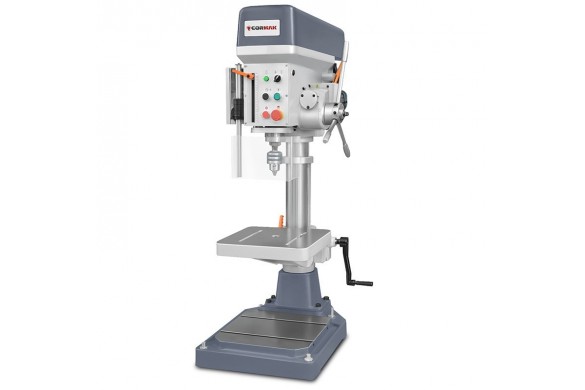
A bench drill has a rigid column, a stable base and an adjustable worktable. The workpiece can be clamped in a vise, fixture or directly on the table and then accurately positioned relative to the spindle axis. This design provides better process control and helps create a repeatable workstation.
The operator can drill holes in steel, aluminium, plastics, wood and other materials. The machine is not limited by the need to attach the base to a magnetic surface. This makes a bench drill suitable for service workshops, locksmith shops, toolrooms, training workshops and production plants.
A bench drill is used for:
- through holes and blind holes,
- countersinks for screw heads,
- hole reaming,
- drilling flat bars, profiles and sheet metal,
- working with hole saws,
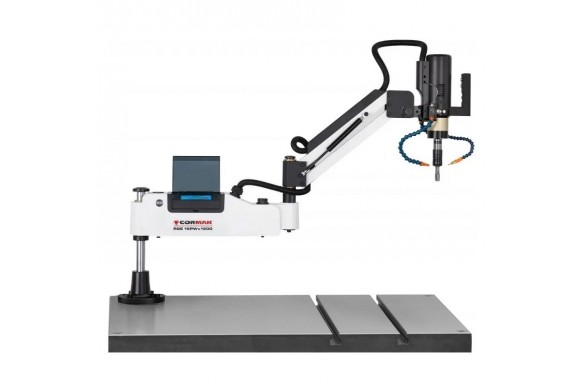
- tapping in models equipped with this function,
- repeatable operations in short production runs.
Thanks to table height adjustment, workpieces of different sizes can be machined. In larger models, the table may also rotate or tilt, which makes angle drilling and workpiece positioning easier.
Drilling accuracy and repeatability
In workshop work, what matters is not only the ability to make a hole, but also its position, perpendicularity and repeatability. The stable design of a bench drill reduces vibration and helps maintain the drilling axis. The workpiece can be securely clamped in a machine vise and its position checked before work begins.
When producing many identical components, stops and simple positioning fixtures can be used. As a result, each hole can be made in the same location without having to mark the dimension from the beginning every time.
A magnetic drill can also provide accurate work, but every setup on a structure requires time and checking. For repeat production, a stable bench drilling station is usually faster and easier to organise.
Speed control and tool selection
Bench drills offer a wide spindle speed range. In simpler models, speeds are changed by repositioning the belts, while VARIO versions allow stepless speed adjustment. This makes it possible to match the speed to the drill diameter, the material and the required hole quality.
Smaller drills usually require higher speeds, while larger diameters and harder materials are machined at lower speeds. Correct speed selection reduces tool overheating, improves chip evacuation and helps achieve a clean hole edge.
A bench drill can work with standard twist drills, centre drills, reamers, countersinks, hole saws and tapping holders. This makes it more versatile than a magnetic drill, which is mainly intended for holes made in large steel structures.
Convenience in daily work
A bench drill creates a fixed workstation. The operator has the vise, tools, coolant, measuring equipment and space for workpieces in one place. There is no need to move the machine or search for a suitable clamping surface every time.
Additional functions are also important in regular work. Selected models may include automatic spindle feed, reverse rotation, a coolant system, a laser drilling-point indicator or a digital speed display. Such equipment improves productivity and helps maintain consistent parameters.
A heavier design is less mobile, but in a workshop this is an advantage. Proper mass and rigidity reduce vibration and ensure stability when drilling larger diameters.
When should you choose a magnetic drill?
A magnetic model is worth choosing when holes are drilled mainly:
- on a construction site or at the customer’s premises,
- in large steel structures,
- in components that cannot be moved,
- on beams, frames and tanks,
- away from a fixed workstation,
- where mobile drilling is needed without dismantling the structure.
It is a complementary machine for installation crews and companies working in the field. It performs best where the workpiece is too large, too heavy or already installed in the structure.
When is a bench drill the better choice?
A bench drill is the better option when most work is carried out in a workshop. It is suitable for different materials, repeatable parts and operations that require stable clamping.
It is also a better solution for workshops that need one machine for drilling, reaming, countersinking and tapping. Its broader application range allows it to handle more types of jobs than a magnetic drill.
Before buying, it is worth checking the maximum drilling diameter, spindle speed range, spindle travel, spindle taper, table size, additional functions and the possibility of stable workpiece clamping. In practice, these parameters determine whether the machine will be convenient for everyday use.
Summary
A magnetic drill is useful for mobile machining of large steel structures. Its main advantages are compact dimensions, the ability to drill directly on the installed component and the use of an electromagnetic base.
For most workshops, however, a bench drill will be the more versatile choice. It provides stable clamping, a wide speed range, a broader choice of tools and better repeatability. It allows many different operations to be performed at one station, which makes it suitable for both service work and regular production.
Latest blog postsAll articles →