How to Select a Fan for Transporting Wood Chips, Shavings and Dust
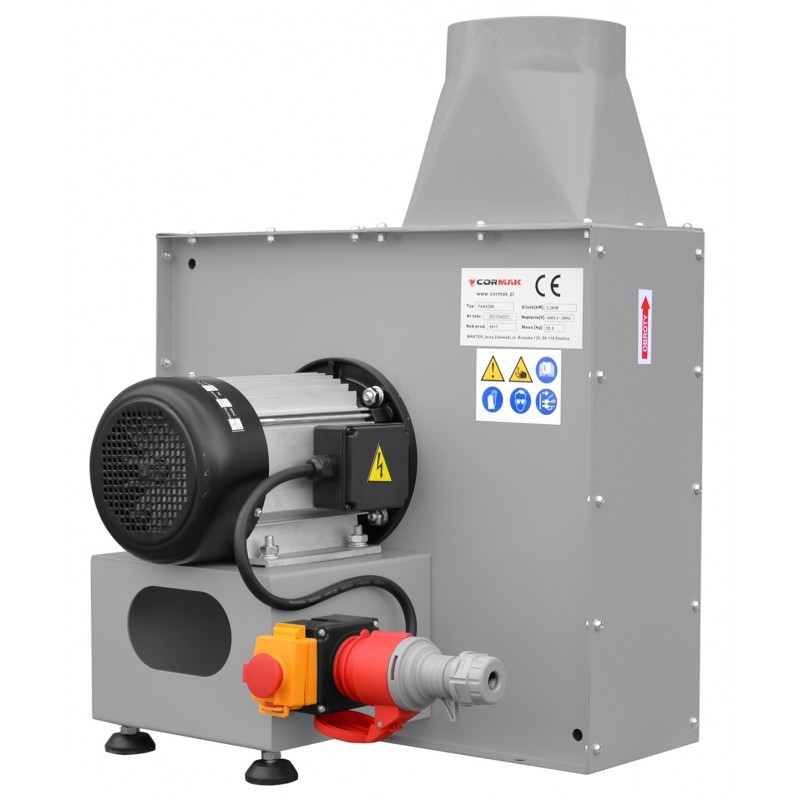
How to Select a Fan for Transporting Wood Chips, Shavings and Dust | Blog - CORMAK
How to Select a Fan for Transporting Wood Chips, Shavings and Dust
Choosing the right fan for dust extraction or pneumatic transport of bulk material such as wood chips, shavings and dust is critical for system performance, workplace safety and installation durability. An undersized fan will not convey material effectively, while an oversized one can increase noise, wear and operating costs.
1. Define the type and amount of waste
Before selecting a fan, determine:
- material type — wood chips, metal shavings, light dust, heavy dust, etc.,
- production rate (kg/h or m³/h),
- material behavior — whether it settles easily, is sticky or tends to clump.
This helps estimate the required airflow and separation performance.
2. Calculate airflow (m³/h)
Airflow defines how much air must move through the ducting to convey contaminants. It depends on:
- duct diameter and total length,
- number and size of inlets/branches,
- pressure-loss factors across the installation (system resistance).
In practice, larger workshop systems often require roughly 2,000–8,000 m³/h, depending on the number of stations and duct sizes.
3. Determine required operating pressure (Pa)
Operating pressure (the pressure difference the fan must overcome) is crucial for long duct runs and systems with many elbows and bends. The more resistance, the higher the required pressure.
- short installations → lower pressure,
- long installations with many direction changes → higher pressure demand.
4. Choose the right fan type
For transporting chips and dust, the most common choices are:
- axial fans – suited for lighter fractions and low resistance,
- radial/centrifugal fans – suitable for heavier fractions and horizontal conveying,
- high-vacuum fans – ideal for even the heaviest fractions in both vertical and horizontal transport.
5. Account for filtration and separators
The transport system must be connected to separators and filters (e.g., cyclones, fabric filters) that capture dust and fine particles. Filter selection affects pressure losses and therefore fan sizing.
6. Motor power and energy efficiency
Select motor power so the fan can operate with a margin, avoiding overload and overheating. Higher-efficiency fans reduce energy use at the same performance level.
Common mistakes when sizing a fan
- choosing “by eye” without calculating system losses,
- ignoring material characteristics (fine dust vs heavy shavings),
- excessive rotational speed causing noise and accelerated wear,
- overlooking the impact of filtration on pressure losses.
Summary
When selecting a fan for transporting chips, shavings and dust, focus on real installation parameters: airflow, system resistance, operating pressure and material characteristics. A properly selected fan ensures reliable conveying, lower noise and reduced operating costs—especially when combined with efficient separators and filters. Modern fans used in CORMAK systems offer a wide operating range and high energy efficiency.
Latest blog postsAll articles →