Cyclone Dust Extractor or Industrial Extractor for a Woodworking Shop?
Cyclone Dust Extractor or Industrial Extractor for a Woodworking Shop?
Effective removal of chips, shavings and wood dust affects work quality, machine life and overall cleanliness in the workshop. When choosing a dust extraction system for a woodworking shop, the most common comparison is between a cyclone system and a conventional industrial extractor fitted with bags, containers or filters.
Both solutions can work with panel saws, planers, spindle moulders, sanding machines and CNC routers. However, they differ in the way they separate contamination, the efficiency of filtration and the scope of use. In practice, a cyclone dust extractor and an industrial chip extractor are not always competing solutions. In more developed installations they often work together.
How does a cyclone dust extractor work?
A cyclone dust extractor uses a swirling airflow. Contaminated air enters the separator, where heavier chips and shavings are thrown against the walls and then fall into a collection bin. Air with finer dust is directed further to a filter or to an additional dust extraction unit.
The main advantage of the cyclone is that it relieves the filters. Most large chips go directly into the container, so the filter clogs more slowly and maintains proper airflow for longer. This is particularly important where machines operate intensively and generate a large volume of waste material.
This solution works well with planers, thicknessers, spindle moulders and machines that remove a large amount of material. A cyclone extractor is also practical in workshops that want to reduce the frequency of cleaning or replacing filters.
A cyclone alone, however, does not always provide sufficient fine-dust filtration. The smallest particles can pass further with the air, so the separator should work with a properly selected filtration system.
What is an industrial chip extractor?
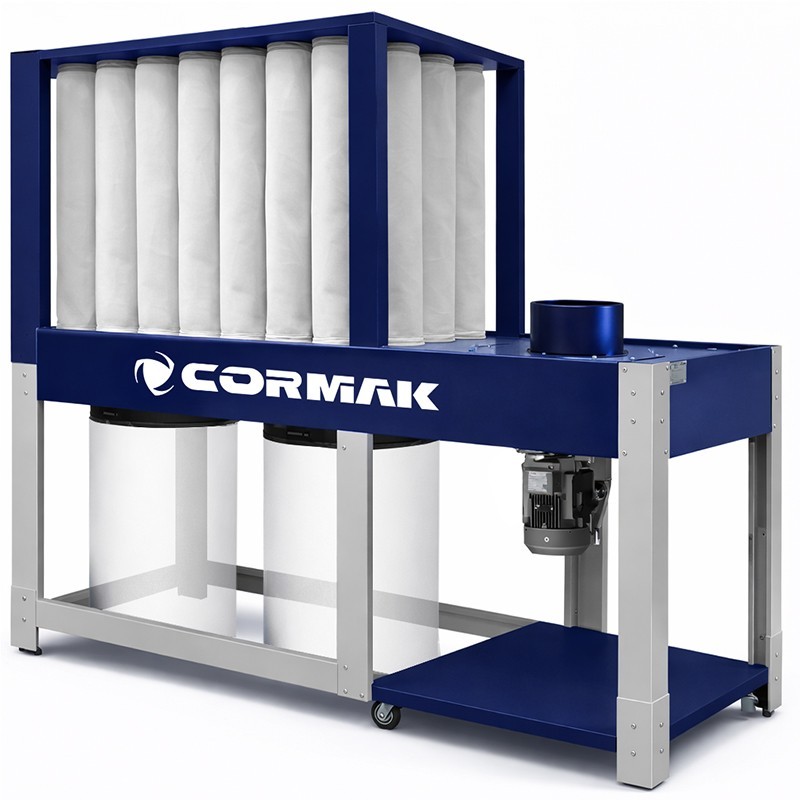
An industrial extractor collects contamination directly from machine outlets and transports it to bags, containers or filters. It may serve one workstation or a complete ducting system connected to several woodworking machines.
Industrial units are available in different airflow capacities. Smaller models may work with a saw, milling machine, sander or planer. Larger systems are designed for production plants where several stations operate at the same time.
The key advantage is the ability to capture not only chips but also fine wood dust. The filter type is crucial. A simple fabric bag may retain larger particles, but sanding, MDF cutting, laminate board machining or CNC work require more accurate filtration.
When should you choose a cyclone system?
A cyclone dust extractor is a good choice when the workshop produces a lot of heavy chips and shavings. This applies especially to intensive operation of planers, thicknessers, multi-rip saws, spindle moulders and machines that remove large cross-sections of material.
A cyclone separator is also useful when filters clog quickly and the operator has to empty bags frequently. Separating larger contaminants before the filter helps maintain stable extraction performance and reduces maintenance time.
A cyclone system is worth considering when:
- planers and thicknessers work every day,
- the installation carries a large amount of heavy chips,
- filters in a standard extractor quickly lose airflow,
- the workshop wants to reduce bag-emptying frequency,
- stable extraction performance is important during longer operation.
Additional space for the separator, collection bin and ducting must be considered. The system must also be airtight, because leaks reduce suction power at the machine. Proper duct routing and matching outlet diameters to the real airflow are also important.
When is an industrial extractor the better choice?
A conventional industrial extractor is suitable for a small or medium-sized woodworking shop with several basic machines. A compact unit can be placed next to a workstation or connected to a short ducting system.
A larger central extraction system is worth using when machines operate at the same time and are located in different parts of the hall. In this case, airflow must be selected according to the number of open extraction points, duct diameters and resistance across the whole installation.
When manufacturing furniture from MDF, plywood and laminated boards, efficient fine-dust filtration is especially important. High fan output alone is not enough if the filter area is too small or the filter does not capture sufficiently small particles.
Cyclone and filtration: the best combination for larger shops
In an intensively operating woodworking shop, the most practical option may be a two-stage system. The cyclone separates most chips and shavings, while the final filter captures fine dust. This combination reduces filter clogging, helps maintain constant airflow and makes waste emptying easier.
Before purchasing, it is worth checking airflow, negative pressure, outlet diameter, filter type and the number of machines that may work at the same time. Duct length, number of bends, the way cleaned air is discharged and the possibility of future system expansion are also important.
What should you check before choosing an extractor?
The selection should be based on real working conditions. Comparing motor power alone is not enough. More important is how much air the unit can actually move through the whole installation and whether it can maintain proper chip transport velocity in the ducting.
Before purchase, check:
- the number of machines connected to the system,
- the number of workstations operating simultaneously,
- outlet and duct diameters,
- the type of contamination generated,
- filter area and filtration class,
- bag or bin capacity,
- available space in the workshop,
- ease of cleaning and emptying.
Long ducts, sharp bends and leaking joints should be avoided. Every additional resistance reduces extraction efficiency at the machine. Even a powerful unit can perform poorly if the installation is badly designed.
Summary
A cyclone dust extractor is best suited to large amounts of chips and shavings. It relieves filters, simplifies waste emptying and helps maintain stable airflow. An industrial extractor with a suitable filter is better for fine dust and can serve one workstation or a larger ducting system.
In larger workshops, the most effective solution is often a cyclone separator combined with precise filtration. A properly selected dust extraction system improves cleanliness, reduces dust build-up on machines and helps maintain stable production conditions.
Latest blog postsAll articles →