CNC Router for Wood – Vacuum Table or Mechanical Clamps?
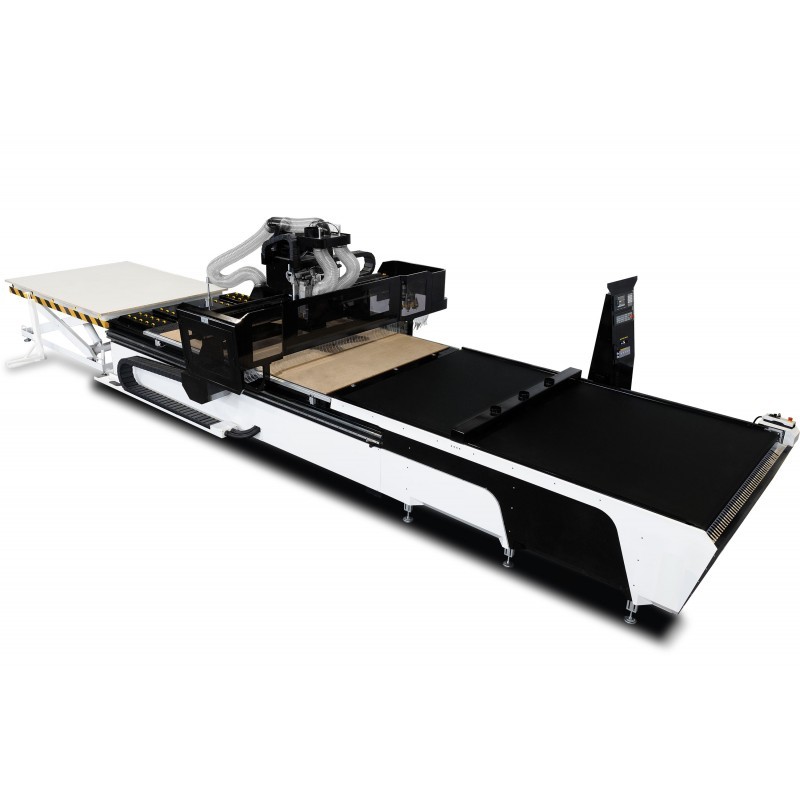
CNC Router for Wood – Vacuum Table or Mechanical Clamps?
A CNC router for wood can significantly speed up the production of furniture, fronts, built-in units, doors, decorative elements and solid-wood components. However, spindle power, working area and software alone are not enough to achieve repeatable quality. Stable material holding is critical. If a board or workpiece moves by even a few millimetres, machining may end with dimensional errors, a broken tool or a damaged component.
Two workholding systems are most commonly used on CNC routers: a vacuum table and mechanical clamping. The first uses negative pressure generated by a pump; the second relies on clamps, hold-downs, screws, stops and fixtures. Both systems have their place in production. A vacuum table makes sheet processing and nesting faster, while mechanical clamps provide secure holding for solid wood and irregular workpieces.
Why is workholding so important?
During routing, the material is affected by cutting forces, vibration and loads generated by axis movement. If the workpiece is not held correctly, it can move, lift, flex or start vibrating. This may result in inaccurate holes, uneven edges, a broken cutter or a collision with a clamping element.
Good workholding also affects productivity. In serial production, the important factor is not only spindle running time but also how long it takes to prepare the next sheet or part. If the operator spends several minutes setting clamps, checking their position and adjusting the program, the machine is idle. That is why the choice of a holding system should be linked to the real workflow, batch size, material type and frequency of changeovers.
How does a vacuum table work?
A vacuum table uses negative pressure to hold the board on the working surface. The vacuum pump removes air from underneath the material, and the pressure difference presses it against the table. Depending on the machine design, a CNC router for wood may use a grid table, sectional table or zoned table with an MDF spoilboard.
Vacuum zones allow the operator to activate only the part of the table covered by the material. This prevents unnecessary loss of suction on empty areas. The MDF spoilboard performs an important technological function: it levels the working surface, distributes vacuum and protects the machine table. It must be resurfaced periodically to maintain flatness and sealing performance.
Vacuum holding is most often used for MDF, plywood, laminated boards, HDF and other flat wood-based panels. It works well for grooving, drilling, machining hardware pockets and cutting furniture parts from full sheets.
Main advantages of a vacuum table
The greatest advantage is fast setup. The operator places the board, opens the relevant zones and starts the program without installing multiple clamps. This shortens preparation time and reduces the risk of mistakes when positioning holding elements.
With no clamps above the material, the cutter has free access to the entire surface. The programmer can arrange parts more efficiently on the sheet, and the operator does not have to avoid clamping points. This is particularly important in nesting, where many furniture components are cut from a single board.
A vacuum table also supports repeatability. Each board is pressed over a large surface, making it easier to keep stable machining conditions from one cycle to the next. In the production of carcasses, fronts, shelves, cabinet sides and built-in furniture elements, this system helps increase throughput and reduce manual handling.
Limitations of vacuum holding
Vacuum works best when the material is flat, relatively airtight and has a sufficiently large contact area with the table. Problems may occur with solid wood, warped sheets, porous materials or parts with an uneven underside. Leaks reduce holding force, so the condition of the MDF spoilboard, seals, zones and pump is important.
Small parts require special care. During through-cutting, the available vacuum area gradually decreases. A light part can move or be lifted by the cutter, especially near the end of machining. In practice, operators use tabs, leave a thin skin for later finishing or plan the cutting sequence accordingly.
It should not be assumed that every board will hold in the same way. Low-density boards or materials with an open structure can leak air. Before starting production, it is worth testing the real material and checking whether the vacuum force is sufficient for the planned operation.
What is mechanical clamping?
Mechanical clamping uses physical elements to hold the workpiece: clamps, screws, hold-downs, stops, vises or special fixtures. The material is located in a defined position and pressed against the table. This solution provides high holding force regardless of surface porosity or air leakage.
Clamps are particularly useful for solid wood, thick boards, beams, stair treads, doors and irregularly shaped parts. Natural wood may be slightly warped, vary in thickness or contain internal stresses. Mechanical holding helps immobilise such material and limit movement during spindle operation.
This solution is also valuable for prototypes and short runs. The operator can adjust clamp positions to a specific workpiece without preparing the entire vacuum zoning arrangement.
Advantages and limitations of clamps
The key advantage of clamps is secure holding. Properly positioned mechanical elements can hold heavy, tall and irregular parts that may be difficult for a vacuum table. They also make it easier to machine materials with a small contact area.
The drawback is longer setup time. Each clamp must be positioned, and its location must be considered in the program. The cutter must not enter the clamping area, because a collision can damage the tool, table, spindle and workpiece. When processing large numbers of repeatable sheets, mechanical clamping time can reduce machine utilisation.
Clamps also limit access to parts of the material. Sometimes the operator has to machine in two stages or reposition the workpiece so that the cutter can reach all areas. For that reason, clamps are not the best option for intensive full-sheet nesting, but they are a valuable addition for custom jobs.
Vacuum or clamps – what should a furniture shop choose?
A vacuum table is the best choice for shops that regularly process MDF, laminated boards and plywood. It is particularly beneficial for serial production of furniture, fronts, carcasses and parts cut from full sheets. It provides fast material loading, high repeatability and easier use of the board surface.
Mechanical clamping is better for solid wood, custom parts, thick elements and one-off production. It is also worth choosing when the material is warped, uneven or has a small contact area with the table.
In many professional workshops, the best results come from combining both methods. The vacuum table handles everyday sheet processing, while mechanical clamps are used for non-standard elements. This arrangement gives flexibility without sacrificing efficiency.
Costs, maintenance and workflow
Before purchasing a router, it is worth analysing not only the price of the machine but also the cost of the vacuum pump, energy, MDF spoilboards, seals and maintenance. With clamps, the main factors are operator time, number of changeovers and the risk of collision caused by an incorrectly prepared program.
In a shop producing many similar parts, a fast vacuum system usually provides a better return, even if the initial investment is higher. For short runs, prototypes and highly varied work, simple clamps may be the more rational solution.
Summary
A CNC router for wood should be selected not only according to material size, spindle power and software, but also according to the workholding method. A vacuum table provides speed and convenience for sheet materials, while mechanical clamps provide stability for solid wood and demanding workpieces.
The best choice depends on the production technology, batch size, type of parts and changeover costs. If the shop mainly processes boards, vacuum holding is the right direction. If it often machines solid wood, non-standard elements or short runs, clamps remain essential. In practice, the most versatile CNC workstation often combines both systems.
Latest blog postsAll articles →