Welding Fume Extractor – How to Choose the Right Capacity?
Welding Fume Extractor – How to Choose the Right Capacity?
A welding fume extractor removes smoke and dust generated during welding, grinding and other metalworking operations. To reduce the spread of contaminants effectively, its capacity must match the workstation, welding process and work intensity. An undersized extractor may fail to capture enough fumes, while an oversized unit can create unnecessary noise, energy consumption and operating costs.
When selecting a system, it is not enough to look only at the maximum airflow value given in cubic metres per hour. Arm design, filter type, pressure losses, the distance between the extraction hood and the weld, and the number of workstations operating at the same time are just as important.
Why does extractor capacity matter?
Welding fumes rise directly above the weld zone. The most effective method is to capture them as close to the source as possible, before they spread across the workshop. A correctly positioned hood helps reduce the amount of contamination reaching the operator’s breathing zone and the surrounding area.
High fan capacity alone does not guarantee good performance. If the extraction arm is too far away, ducts are leaking, the filter is heavily clogged or the workstation layout is unfavourable, the actual suction force at the weld can be much lower than the catalogue value.
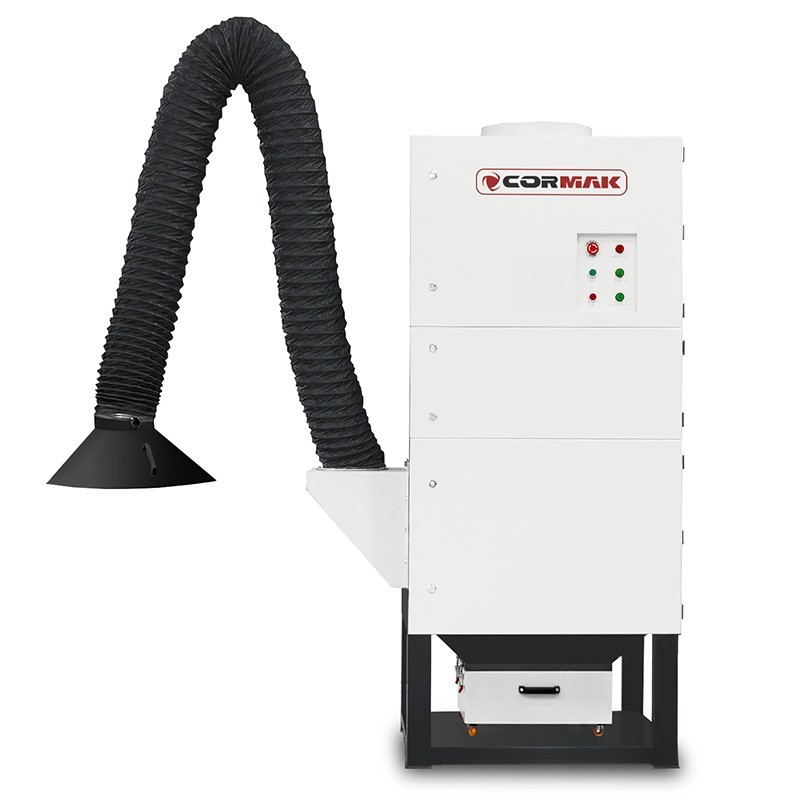
That is why a welding fume extractor should be assessed as a complete system: fan, filters, ducts, extraction arm, hood geometry and the way the hood is positioned in relation to the welding area.
Type of welding process
The amount of fume depends on the welding method. MIG/MAG welding, especially at higher intensity and on coated materials, may generate significantly more contamination than light TIG work. Higher extraction demand can also be expected when welding long seams, using higher current levels or working over long shifts.
Other factors include the type of electrode or wire, base material, surface condition, seam length, working hours per day and additional operations such as grinding, cleaning or local heating.
A workstation used occasionally for short welds will have different requirements than serial production, where the operator welds for most of the shift. The more intensive the process, the greater the airflow and filtration performance required.
One workstation or several?
A mobile welding fume extractor is usually designed for one workstation. It can be moved between work areas, but at any given time it should capture fumes from one source.
If several workstations operate simultaneously, a multi-arm unit or a central extraction system should be considered. In such cases, simply multiplying the airflow of one extractor by the number of stations is not enough. Duct length, airflow resistance, bends, duct diameters, simultaneity of operation and pressure losses throughout the system must also be included.
Each additional arm increases the required airflow. If a unit has two arms and both are used at the same time, the fan must provide sufficient suction at both points, not only a high maximum value measured under ideal conditions.
Length and diameter of the extraction arm
The extraction arm should allow the hood to be positioned as close to the weld as possible without limiting the operator’s movement. A longer arm increases reach, but may also create higher airflow resistance. Its length should therefore be selected according to the real workstation layout, not only the maximum possible range.
The duct diameter also affects performance. A diameter that is too small restricts airflow and may increase noise. An oversized hood placed far from the workpiece may draw in a large amount of surrounding air but capture the fumes above the weld poorly.
In practice, correct arm positioning often has a greater impact on extraction efficiency than a small difference in the rated capacity of two similar units. Even a powerful extractor will not perform properly if the hood is too far from the fume source.
Filters and real operating capacity
The extractor should be fitted with filters suitable for the type of contamination. During operation, dust gradually settles on the filter surface, increasing airflow resistance. If the filter is not cleaned or replaced regularly, the unit’s performance drops and the fan works under more difficult conditions.
For intensive use, it is worth choosing a model with automatic or convenient manual filter cleaning. Filter surface area is also important. A larger filter can maintain stable airflow for longer and require less frequent maintenance.
The dust container design should also be checked. Easy access to the filter, drawer or collection bin simplifies maintenance and reduces workstation downtime, especially when the extractor operates every day in demanding processes.
How to select the right capacity?
The selection process should start with the number of workstations operating at the same time and the type of work performed. Then the arm length, welding intensity, workstation layout and filtration method should be considered.
For a single workstation, a mobile unit with one arm and airflow adjustment is usually sufficient. For two workstations, either a unit designed for two-arm operation or two separate extractors should be used. For a larger number of stations, a central extraction system is worth analysing.
A moderate capacity reserve is recommended, especially if production may expand. However, excessive oversizing does not always improve effectiveness, because local fume capture and correct hood positioning remain essential. The best results come from the combination of proper airflow, effective filtration and an ergonomic arm.
Common selection mistakes
One of the most common mistakes is choosing the unit based only on the maximum fan capacity. Other problems include placing the hood too far from the weld, using overly long ducts, neglecting filter cleaning and using one extractor for several active stations even though the unit was not designed for that task.
Another mistake is ignoring the nature of the process. A workstation for occasional repair work has different requirements than serial production, welding large structures or working with materials that generate heavy fumes.
Summary
The capacity of a welding fume extractor should be matched to the welding process, number of workstations, arm length and intensity of use. Airflow value alone is not enough to evaluate the device.
An effective extractor should capture fumes as close to the weld as possible, maintain stable suction as the filter becomes loaded and allow easy adjustment of the extraction arm. A properly selected system improves workstation organisation, limits dust dispersion and supports safer working conditions in workshops and production plants.
Latest blog postsAll articles →