Welding Fume Extraction – Why It Matters and How to Choose the Right Solution
Welding Fume Extraction – Why It Matters and How to Choose the Right Solution
Welding fume extraction is part of a system designed to reduce exposure to fumes and dust created during welding. A well-designed source-capture arrangement can improve working conditions, visibility at the weld and cleanliness at the workstation.
The choice should not be based solely on fan power or stated airflow. Key factors include the welding process, base material and coatings, number of workstations, work position, fume-capture method and planned filter maintenance.
What Is Welding Fume Extraction?
Welding fume extraction is local or workstation ventilation designed to capture fumes and dust as close as practicable to where they are generated. It commonly consists of a capture device, ducting, fan, filtration module and either exhaust discharge or, in suitably engineered systems, return of cleaned air.
Welding fumes can contain very fine particles and compounds that depend on the material, process and consumables. For this reason, one universal unit is not suitable for every task: the system should follow a risk assessment and the conditions of the specific workstation.
Extraction does not replace other controls. It is one element in the hierarchy of exposure control, alongside work organisation, general ventilation, suitable personal protective equipment and technical checks.
Why Is It Important?
Welding can generate fumes, dust and gases whose composition depends on the technique, base metal, wire or electrode and any surface coating. Worker exposure should primarily be controlled at the source of emission.
A correctly selected system can support:
- reduced spread of contaminants in the welder’s breathing zone;
- better visibility while making a weld;
- cleaner workstations and less dust deposition on equipment;
- more orderly work where multiple stations operate;
- controls arising from occupational-risk assessment and workplace safety arrangements.
Effectiveness depends primarily on the capture device being correctly positioned relative to the fume source and on proper use and maintenance of the system.
Types of Welding Extraction Systems
Local extraction arms
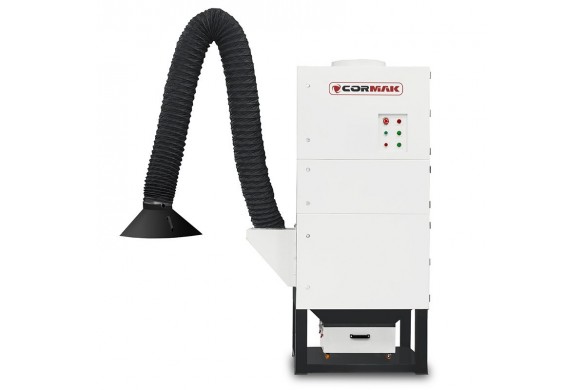
An extraction arm allows the hood to be positioned close to the welding point. It is a common choice for fixed or semi-fixed stations, especially where the welding position and part size vary within a limited range.
- source capture close to the emission;
- good workstation access;
- connection to a central system or a standalone filter unit.
Welding tables with extraction
An extraction table combines the working surface with an extraction system. It can suit repeatable work on parts that fit the table dimensions.
- compact solution for one workstation;
- down-draft or slotted-table capture;
- easier to maintain consistent part positioning.
Central systems
A central system serves multiple stations. It requires engineering that accounts for simultaneous use, system resistance, contaminant type, filter selection, controls and safe handling of filter waste.
- multiple extraction points;
- centralised control and monitoring;
- need for professional design and system balancing.
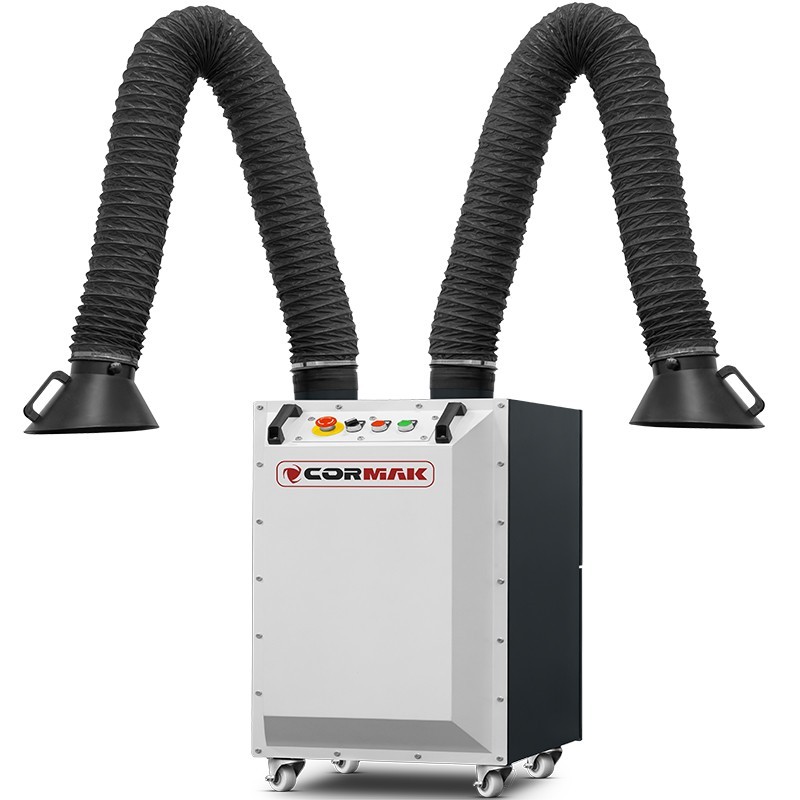
Mobile welding extractors
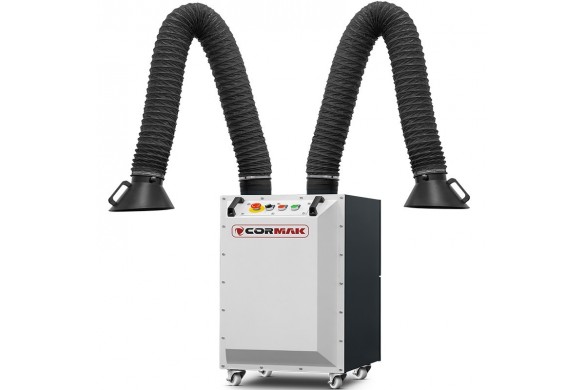
Mobile filter units are useful where workstations change location or short production runs are performed. Their effectiveness depends on correct positioning of the arm or hood, as well as filter condition and machine capacity.
- flexibility across different areas of a workshop;
- no need for an extensive fixed duct network;
- space, power and regular filter servicing are still required.
On-torch extraction
Some welding processes can use fume-extraction torches. This can control fume at the point of generation, but must be matched to the welding method, work ergonomics and extraction parameters.
What to Consider When Choosing a System
Process and materials
Consider the welding method, base metal, consumables, coatings and surface treatments. Stainless steel, galvanised materials, painted parts and oil-contaminated surfaces may present different risks.
Number of stations and simultaneous work
Airflow and system size should reflect the real operating scenario. For a central system, establish how many stations operate at the same time and what capture requirements each point has.
Capture efficiency
The key is to capture fume as close as practicable to the arc or emission point. Excessive hood distance, adverse draughts or placing the workpiece between the fume source and hood can significantly reduce performance.
Airflow, pressure and system resistance
Fan parameters must be assessed together with duct length, bends, duct diameters, filters and capture devices. A high stated airflow for a unit alone does not guarantee effective capture in a completed installation.
Noise, ergonomics and service access
Compare noise level, arm reach, ease of positioning, filter access, waste-emptying method and availability of consumables and service support.
Filtration, Discharge and Recirculation
Filtration must be selected for the contaminants and process requirements. A system may use mechanical filtration, cartridges of a defined class, spark separation or other manufacturer-specified solutions. Activated-carbon filters are mainly used for certain gases and odours; they are not a universal substitute for particulate filtration.
Whether air is discharged outdoors or recirculated requires technical analysis, risk assessment, compliance with applicable requirements and the manufacturer’s instructions. Consider contaminant composition, filter performance, filter-condition monitoring and supply-air requirements.
Processes that generate sparks or hot particles may require additional fire or explosion protection measures. These should be selected for the specific process and dust properties, rather than assuming every standard filter is suitable.
Occupational Safety and Health
Employers should identify hazards, assess occupational risks and apply controls that reduce worker exposure. In practice, the ventilation and extraction design should be linked to real working conditions, exposure assessment and workstation instructions.
Local extraction is particularly valuable because it removes contaminants close to the source. General ventilation may support it, but should not normally be treated as the sole control for processes that generate substantial fume.
Personal protective equipment, including suitably selected respiratory protection, may provide an additional layer of control. It should not replace effective emission control and fume capture where these are technically feasible.
Operation and Maintenance
Even correctly selected extraction will not work effectively without proper operation. The service schedule should follow the manufacturer’s instructions, work intensity and contaminant type.
- check hood or arm position relative to the fume source;
- inspect filters, ducting, seals and capture components;
- clean or replace filters according to instructions and safe waste-handling procedures;
- keep grilles, connections and safety components unobstructed;
- perform periodic inspections and tests required for the system and workplace;
- train operators to position and use the extraction correctly.
Common Selection and Operating Mistakes
- Keeping the hood too far from the source: capture effectiveness decreases sharply with distance.
- Selecting only by m³/h: the full system, including duct and filter resistance, must be considered.
- Using filters unsuitable for the contaminants: filter type must match the process and manufacturer guidance.
- Neglecting maintenance: loaded filters and leaks reduce performance and raise operating costs.
- Ignoring draughts: uncontrolled airflow can move fume away from capture into the breathing zone.
- Treating extraction as the only control: it should be part of a wider safety programme.
Mobile Extractor, Extraction Arm or Central System?
| Solution | Best use | Strengths | Points to consider |
|---|---|---|---|
| Mobile extractor | Changing work locations, short runs | Flexibility, no fixed ductwork | Positioning, filter capacity, power access |
| Extraction arm | Fixed or semi-fixed station | Capture close to source, easy positioning | Reach, system resistance, operator positioning discipline |
| Central system | Multiple stations, production work | Multiple points, central filtration | Design, balancing, simultaneous use and maintenance |
Summary
Welding fume extraction is an important part of safer welding operations. The best system is not necessarily the unit with the highest stated airflow; it is the solution matched to the process, materials, workstations and working practices.
Before purchase, assess emission sources, number of operating stations, capture method, filtration, servicing and workplace-safety requirements. Design and commissioning of larger installations should be assigned to competent specialists.
Latest blog postsAll articles →