Welding Fume Extraction and Worker Health – Which Hazards Does It Reduce?
Welding Fume Extraction and Worker Health – Which Hazards Does It Reduce?
Welding is essential across many industries, but it also releases fumes and gases that can degrade air quality at the workstation. Welding fume extraction is one of the main engineering controls used to reduce exposure because it captures contaminants as close as possible to where they are generated.
A correctly selected extraction system does not remove every risk on its own. Effective protection combines local extraction, general ventilation, sound work organisation, equipment maintenance and, where a risk assessment requires it, suitable respiratory protective equipment.
What Are Welding Fumes?
Welding fumes are a mixture of very fine solid particles and gases generated during welding and other hot-work processes. Their composition varies according to welding method, base metal, consumables, surface coatings and process settings.
Depending on the process, fumes may contain:
- metal particles and oxides such as iron or manganese;
- chromium and nickel compounds, especially when welding stainless steel;
- gases and reaction products, including ozone and nitrogen oxides under particular process conditions;
- fine and ultrafine particles that can travel deep into the respiratory system.
For this reason, not all welding processes should be assessed in the same way. Risk assessment should take account of the exact welding method, material, consumables, coatings and ventilation conditions at the site.
How Can Welding Fumes Affect Health?
Inhaling welding fumes can affect the respiratory system, eyes and skin. The nature and level of risk depend on contaminant concentration, exposure duration, process type and the effectiveness of control measures.
The risk is not limited to the welder. People working near the welding area may also be exposed if fume spreads through the workshop or production hall without being captured effectively at source.
Short-Term Exposure Effects
Where ventilation is insufficient or extraction is incorrectly positioned, workers may experience symptoms associated with airborne contaminants. These can include:
- eye, nose and throat irritation;
- coughing, breathing discomfort or shortness of breath;
- headaches, weakness or reduced wellbeing;
- reduced visibility in the welding area due to lingering fume.
These signs should not be ignored. They should trigger a review of the emission source, extraction position, ventilation performance and protective measures in use.
Long-Term Exposure Risks
Regular exposure to welding fumes may be associated with more serious health effects. In practice, particular attention is given to respiratory diseases, including occupational asthma, and to cancer risk related to welding-fume exposure.
When welding materials containing chromium or nickel, especially careful risk assessment and exposure control are needed. Manganese compounds present in certain fumes may also require attention because of potential neurological effects during long-term, uncontrolled exposure.
Risk depends on the actual working conditions, so it cannot be assessed reliably from the type of machine alone. Exposure measurements, occupational risk assessment, condition of the extraction system and operator working practices all matter.
How Does Welding Fume Extraction Reduce Exposure?
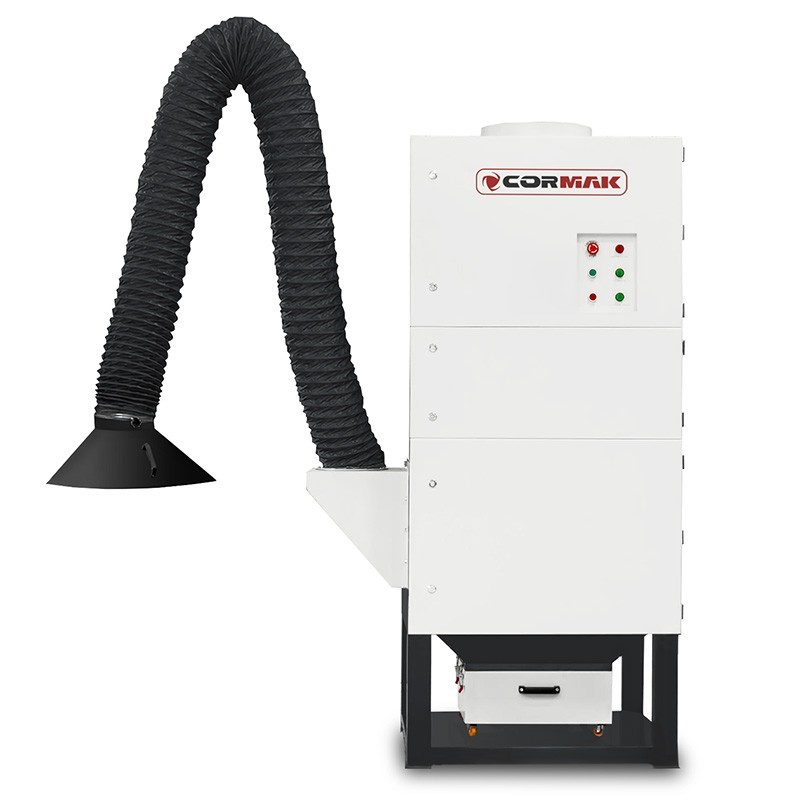
Welding fume extraction reduces worker contact with contaminants by capturing fume close to the welding arc before it spreads through the work area and building. Depending on the application, this may involve an extraction arm, on-torch extraction, an extraction table, a mobile unit or a central system.
An effective system can:
- reduce the amount of fume in the worker’s breathing zone;
- limit the spread of contaminants to adjacent workstations;
- improve visibility during welding;
- support cleaner conditions in the work area;
- help meet requirements arising from risk assessment and workplace safety practices.
Effectiveness depends on correct positioning of the hood, arm or nozzle in relation to the fume source. Even a high-capacity unit will perform poorly if the capture point is too far away, positioned on the wrong side of airflow or fitted with a saturated filter.
Workstation With and Without Extraction
| Area | Without effective extraction | With correctly used local extraction |
|---|---|---|
| Fume spread | Fume may remain in the work zone and travel through the building | A significant share of contaminants is captured close to the source |
| Operator conditions | Greater likelihood of working in a visible fume cloud | Better visibility and lower exposure when the system is correctly positioned |
| Exposure of nearby workers | May affect employees working nearby | Helps limit fume migration across the facility |
| Housekeeping | More deposits and dust in the surrounding area | Cleaner work environment, dependent on filtration and maintenance |
Workplace Safety and Organisational Responsibilities
Employers should identify hazards, assess occupational risk and apply controls that reduce exposure to harmful agents. For welding work, this includes appropriate workstation design, effective ventilation and selecting protection suitable for the process.
Local extraction is an important engineering control, but it does not remove the need to check whether it works properly. The system should be maintained, periodically inspected and used in accordance with the manufacturer’s instructions. Formal requirements and the scope of exposure monitoring should always be established for the individual workplace and applicable regulations.
Is Extraction Alone Enough?
Welding fume extraction is a primary collective protective measure, but in many situations it should form part of a broader control system. Protection should follow the hierarchy of controls.
- select welding methods and materials that reduce emissions where feasible;
- use local extraction and suitable general ventilation;
- maintain correct positioning of the extraction arm, nozzle or fume-extraction torch;
- use respiratory protective equipment where the risk assessment requires it;
- provide training, work instructions and equipment checks;
- do not weld materials with unknown or unremoved coatings without first assessing the hazards.
How to Choose Extraction for Worker Health Protection
Extraction selection should start with an analysis of the process rather than a comparison of fan power alone. Key criteria include:
- welding method and material type;
- number and layout of workstations;
- frequency and duration of welding work;
- ability to place the capture point close to the fume source;
- filtration type matched to contaminants and service procedures;
- noise, mobility, maintenance access and filter operating costs;
- potential to expand the system as the facility grows.
Filters must be selected for the contaminants and technical solution involved. Not every process requires the same filtration approach, and recirculation of treated air may be subject to additional conditions. Where there is doubt, consult the system supplier and a workplace safety specialist.
Summary
Welding fumes are a significant occupational hazard, so exposure control should be standard at every welding workstation. Local extraction reduces the amount of contaminants in the operator’s breathing zone and can also help protect people working nearby.
The best results are achieved when extraction is matched to the process, correctly positioned, maintained regularly and supported by ventilation, work organisation and suitable personal protective equipment. This approach improves working conditions and helps reduce health risk over the longer term.
Latest blog postsAll articles →