Types of Welds and Welding Seams and Their Markings

Welding is one of the key technologies used in the metallurgical and construction industries. The proper selection of the welding technique and knowledge of the types of welds and welding seams affect the quality and durability of joints. Today, we will present the most important information about various methods of joining metals, their markings, and their application in engineering practice. If you want to learn more, we invite you to read on!
From this article you will learn:
- Types of welds - basic information
- Types of welding seams and their application
- Weld markings and their meaning in technical drawings
- Which welding machines and accessories are worth choosing?
Types of welds - basic information
Welds are divided into several basic types, depending on the arrangement of the elements relative to each other and the method of making the joint. We primarily distinguish such types of welds as:
- Butt welds - used when joining two elements arranged in one plane. They are used in the construction and machinery industries, e.g. in the production of industrial machines.
- Fillet welds - used to join elements positioned at an angle, e.g. 90°. They are used in the welding of steel structures, supporting frames, and machine housings.
- Edge welds - used less frequently, intended for thin metal elements that require edge reinforcement.
The selection of the appropriate weld depends on the design requirements and the loads to which the welded joint will be subjected.
Types of welding seams and their application
Welding seams are the physical formation of a weld, which determines its geometry and strength. Depending on the technology and design of the seam, we can distinguish different types of seams:
- Butt seam - used in the case of butt welds. It can be made without bevelling (for thin sheets) or with edge bevelling, which improves the quality of the joint.
- Fillet seam - common in angular joints, e.g. in the assembly of steel structures. It forms a characteristic triangular cross-section.
- Crest seam - used to reinforce narrow-gap joints, especially in the shipbuilding and aviation industries.
- Lap seam - formed in places where one metal element overlaps another, which provides a large contact surface and strength.
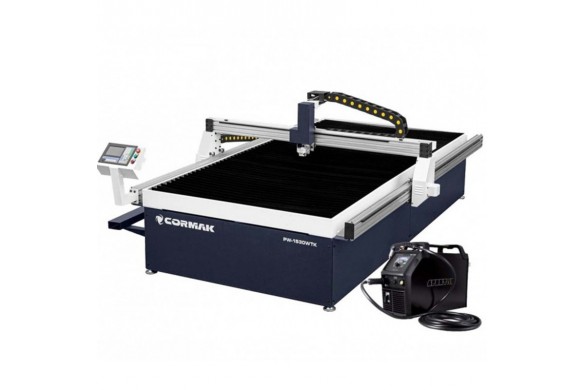
Different types of welding seams can be made using advanced technologies such as laser welders or laser cutters and plasma cutters, which are offered by the industrial machine manufacturer.
Weld markings and their meaning in technical drawings
Every engineer and welder should know the weld markings on a technical drawing, because they precisely define how the joint is to be made. In technical documentation, the following are used:
- Welding seam symbol - specifying its type, e.g. butt, fillet.
- Seam thickness - expressed in millimetres, crucial for the strength of the joint.
- Length and number of seams - allowing their arrangement in the structure to be specified.
- Additional markings - e.g. marking of the welding direction, intermittent or reinforced seams.
Weld markings make it possible to maintain high standards of safety and quality in the production of machines and metal structures.
Which welding machines and accessories are worth choosing?
Appropriate tools are essential to make welds with high durability and precision. In professional facilities, the following are used:
- Metalworking machines - necessary for preparing elements before welding.
- Laser welders - a modern solution allowing precise welded joining of metals without excessive heating of the material.
- Extraction systems for lasers - improving work safety by removing fumes and contaminants.
- Welding accessories - such as helmets, electrodes, and holders, increasing the efficiency of the welding process.
Summary
Knowledge of different types of welding seams and weld markings on a technical drawing is crucial in the metallurgical and engineering industries. The correct execution of a welded joint requires proper preparation of the elements and the use of modern welding technologies. By choosing high-quality industrial machines, such as laser welders, the precision and efficiency of work can be significantly increased.
Latest blog postsAll articles →