Spiral cutterhead or straight-knife cutterhead in a planer?
Spiral cutterhead or straight-knife cutterhead in a planer?
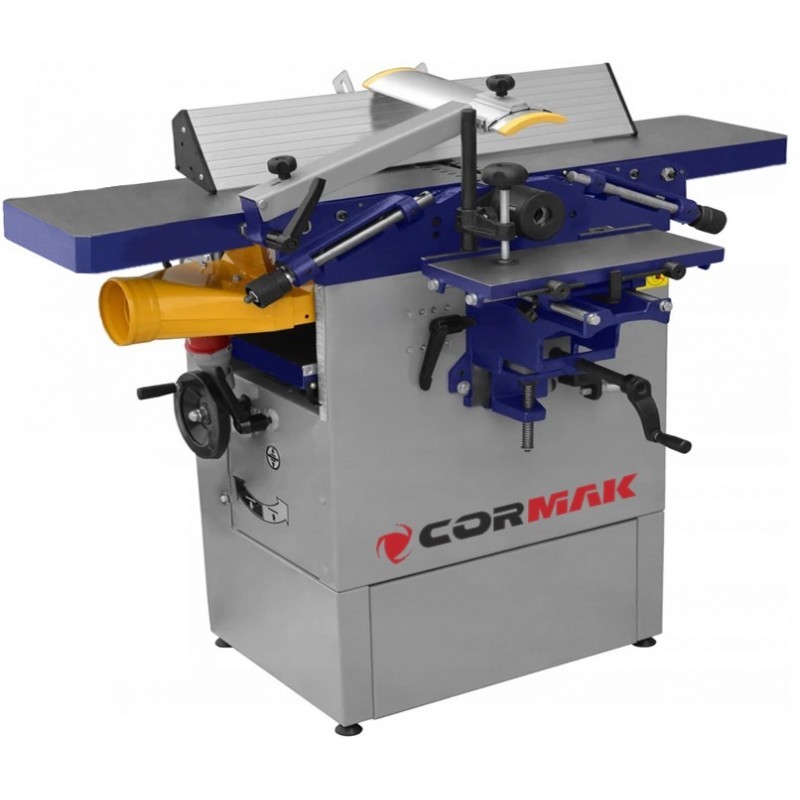
When choosing a jointer, thickness planer or planer-thicknesser, it is worth looking beyond working width, motor power and feed speed. The design of the cutterhead is just as important. This component affects surface quality, noise level, machine load and later operating costs.
The most common comparison is between a traditional straight-knife cutterhead with long knives and a spiral cutterhead fitted with many small cutting inserts. Both solutions can machine wood effectively, but they serve different needs. A straight-knife cutterhead is simpler and cheaper, while a spiral cutterhead offers greater comfort and better results on demanding material.
How does a traditional straight-knife cutterhead work?
A straight-knife cutterhead uses several long blades positioned parallel to the axis of the shaft. During rotation, each blade contacts the workpiece across almost the full width of the material being planed.
This design is widely used in workshop and industrial planers. It works well on softwood and hardwood with relatively regular grain. Correctly adjusted and sharp knives can leave an even surface that often requires only light sanding.
The main advantage of a traditional cutterhead is the lower purchase cost of the machine. The knives can also be sharpened many times, provided they have not been seriously damaged. This makes it an economical solution for workshops processing typical boards, beams and construction timber.
Limitations of a straight-knife cutterhead
A long blade cuts a large portion of the material at once, which is why the machine usually produces a characteristic high noise level. It may also generate more vibration, especially when the knives are poorly set or unevenly sharpened.
Problems also appear around knots and changing grain direction. A traditional knife can tear fibres out instead of cutting them cleanly. The result may be tear-out, recesses or rough areas that require additional sanding.
Damage to one section of the blade affects the entire working width. Even a small chip can leave a visible line on every board. The knife then has to be sharpened again or replaced and carefully set in relation to the other blades.
What makes a spiral cutterhead different?
A spiral cutterhead uses many small cutting inserts arranged around the circumference of the shaft. Depending on the design, the inserts may be set in a spiral pattern or at a slight angle to the feed direction.
During operation, the inserts enter the material gradually. Instead of one wide impact, the cutting action is divided into a series of smaller cuts. This usually makes the process smoother, quieter and less prone to vibration.
The inserts are usually made of carbide. Each insert has several cutting edges. If one edge becomes dull or damaged, the insert can be rotated to use another edge. There is no need to replace or readjust a complete set of long knives.
Better surface quality
The key advantage of a spiral cutterhead is high planing quality. Small inserts cut the wood progressively, which helps reduce tear-out. The difference is especially visible on knotty, hard or irregularly grained wood.
A spiral cutterhead works well on oak, ash, beech and glued timber. It may also be beneficial for parts with alternating grain direction, where traditional knives are more likely to leave torn fibres.
The machined surface is usually more even and requires less intensive sanding. In the production of furniture, stairs, worktops and decorative elements, this can shorten later stages of work and reduce the number of rejected parts.
Noise, chips and machine load
A spiral cutterhead usually operates more quietly than a traditional straight-knife cutterhead. Individual inserts do not strike the material across the full width at the same time, which helps reduce noise and vibration. Hearing protection and safe planer operation are still required.
The process also produces smaller and shorter chips. These can be easier to remove through the extraction system, provided the dust collector has sufficient capacity and the ducts are properly sized.
The gradual entry of the cutters into the material can also reduce peak loads on the drive. This does not mean that a machine with a spiral cutterhead can use an undersized motor. Power still has to match working width, planing depth, feed speed and wood hardness.
Purchase and operating costs
A planer with a spiral cutterhead is usually more expensive than a comparable model with traditional knives. The higher cost results from the more complex construction and the large number of inserts.
Over longer use, part of this difference may be offset. A damaged insert can be rotated or replaced individually without removing the full set of cutters. The operator also does not need to set all long knives to the same height after each sharpening.
A traditional cutterhead remains more economical for occasional work and simple materials. It does, however, require regular sharpening and accurate knife setting, which takes time and can cause downtime.
Which cutterhead should you choose?
A traditional straight-knife cutterhead is a good choice when:
- the planer is used occasionally,
- the workshop mainly processes wood with regular grain,
- a lower purchase cost is the priority,
- professional knife sharpening and setting are available,
- simple construction and standard knives are preferred.
A spiral cutterhead is worth choosing when the machine is used regularly and surface quality, lower noise and reduced tear-out are important. It is especially useful for hard, knotty and demanding wood, as well as in companies producing furniture, stairs, doors or finishing elements.
Summary
A straight-knife cutterhead is a simple and economical solution for standard woodworking tasks. With sharp and correctly adjusted knives, it provides good machining quality, but it may generate more noise and more tear-out on difficult grain.
A spiral cutterhead offers smoother operation, easier insert handling and a better surface after planing. It is more expensive, but in regular production it can reduce sanding time, downtime related to sharpening and the number of damaged parts.
Latest blog postsAll articles →