Lathe tailstock – what is it used for and when should it be used?
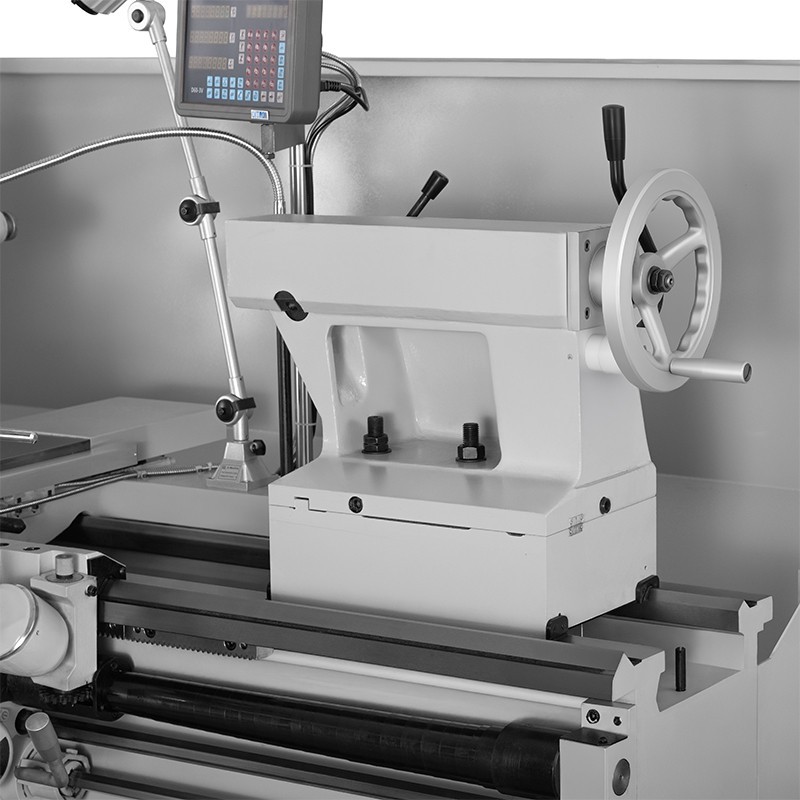
Lathe tailstock – what is it used for and when should it be used?
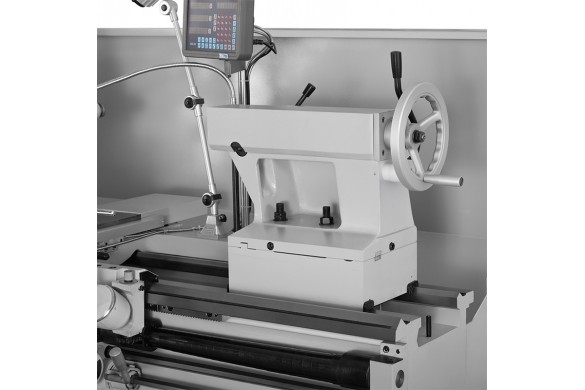
The lathe tailstock is one of the basic components of a conventional lathe. It is located on the opposite side of the headstock and can be moved along the machine bed. Its main task is to support a shaft on the lathe, especially when the workpiece is long, slender or prone to deflection.
The tailstock can also be used to hold tools such as drills, reamers or countersinks. This increases the capabilities of the lathe and allows additional operations to be carried out without moving the workpiece to another machine.
What is a lathe tailstock used for?
The tailstock is most often used to support long parts rotating in the lathe chuck. One end of the workpiece is held in the spindle, while the other is supported with a centre mounted in the tailstock quill.
This solution increases the rigidity of the setup and helps reduce vibration during turning.
A lathe tailstock is used, among other things, when machining:
- long shafts,
- axles,
- pins,
- bars,
- small-diameter components,
- parts that require axial drilling.
The greater the length of the workpiece in relation to its diameter, the higher the risk of bending during machining.
Why is shaft support on a lathe important?
During turning, cutting forces act on the workpiece. If a shaft is long and held only in the chuck, it may start to deflect.
This can lead to poorer surface finish, difficulties in maintaining dimensions and vibration.
Supporting a shaft on the lathe with the tailstock helps reduce these problems. The workpiece is stabilised at two points, which improves rigidity during machining.
This is particularly important when a long section of material protrudes from the chuck.
When should the tailstock be used?
There is no single length value after which the tailstock is always required. The decision depends on diameter, material, overhang, cutting parameters and the required accuracy.
In practice, it is worth using the tailstock whenever the shaft shows a tendency to vibrate or bend.
Support is especially recommended when turning long and thin parts, when using larger depths of cut and when high dimensional accuracy is required.
If the workpiece is short and rigid, the tailstock may not be necessary.
Dead centre or live centre?
Different types of centres can be used in the tailstock.
A dead centre does not rotate with the workpiece. It requires proper lubrication at the contact surface and is mainly used for selected operations.
A live centre has its own bearings and rotates together with the workpiece. It is more convenient at higher spindle speeds and during longer machining cycles.
For most typical workshop applications, a live centre is a very practical solution.
How should the workpiece be prepared for support?
To use the tailstock correctly, a centre hole should be made at the end of the shaft. It should be positioned exactly on the axis of the workpiece and have a geometry matched to the centre being used.
An incorrectly made centre hole can cause runout, uneven support and faster wear of the contact surface.
After positioning the tailstock, the quill should be extended and the centre should be gently pressed against the workpiece. The pressure should be sufficient for stabilisation, but not excessive.
Too much pressure may cause heating, bearing overload or a change in the geometry of a slender shaft.
Tailstock as a tool holder
The tailstock is not used only for support.
A drill chuck or a Morse taper tool can be mounted in its quill. This allows the lathe to drill directly along the axis of the workpiece.
The tailstock can be used for:
- centre drilling,
- drilling,
- reaming,
- countersinking,
- selected threading operations.
In this setup, the workpiece rotates in the spindle while the tool mounted in the tailstock is fed along the axis.
Tailstock and steady rest – what is the difference?
The tailstock supports the workpiece at its end. However, this is not always enough.
With very long shafts, a fixed or travelling steady rest may also be required. It supports the part closer to the cutting area and helps reduce deflection in the middle of the length.
For this reason, the tailstock and steady rest are not competing solutions. In demanding machining, they can be used together.
How should the tailstock be set correctly?
The tailstock should be aligned with the spindle axis. If it is offset from the axis, the machine may turn a taper instead of a cylinder.
Before precision machining, it is therefore worth checking its alignment.
The condition of the guideways and the cleanliness of contact surfaces are also important. Dirt under the tailstock base can affect its position.
After moving the tailstock to the correct position, it should be securely locked on the bed.
When is the tailstock not enough?
With very thin and long shafts, supporting only the end may not eliminate deflection in the middle section.
In such cases, cutting parameters should be reduced or an additional steady rest should be used.
Similarly, with heavy workpieces, the permissible load of the tailstock and the centre should be checked. The supporting element should not carry loads greater than those allowed by the machine manufacturer.
Summary
The lathe tailstock is used mainly to stabilise long and slender workpieces and to hold tools for drilling and other axial operations.
Correct shaft support on a lathe reduces vibration, limits deflection and helps maintain the required turning accuracy. The tailstock should be used wherever the workpiece protrudes significantly from the chuck or its rigidity is insufficient.
A properly aligned tailstock improves safety and machining precision, which makes it one of the most important elements of conventional lathe equipment.
Latest blog postsAll articles →