CNC press brake axes – which ones do you really need?
CNC press brake axes – which ones do you really need?
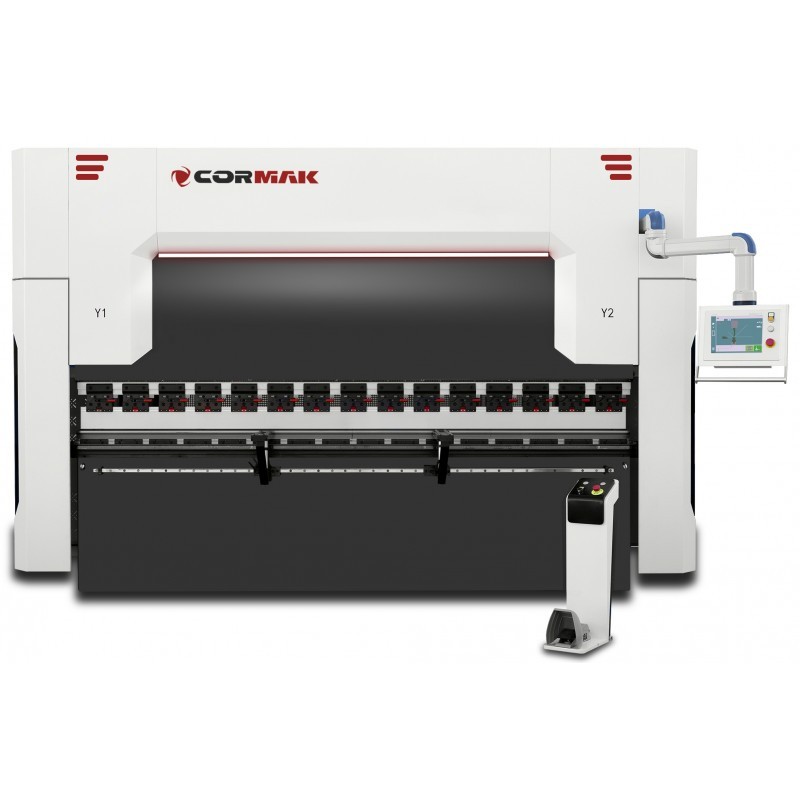
When choosing a CNC press brake, it is easy to focus only on the number of controlled axes. Manufacturers offer 3-axis, 4-axis, 6-axis and 8-axis machines, while the most advanced configurations can include even more controlled movements. More axes do not always mean a better purchase. The right configuration depends on the type of parts, production volume, changeover frequency and required level of automation.
In many workshops, the basic Y1 + Y2 + X configuration is sufficient for simple work. For more complex parts, however, the R axis and Z1/Z2 axes quickly become useful. On long press brakes, automatic crowning, often referred to as the V axis, is also very important.
What do axes mean in a CNC press brake?
Each axis is responsible for a specific movement of the machine, ram or back gauge. The CNC controller positions these axes according to the bending program, so the operator does not have to measure and adjust every step manually.
The most common axes are:
- Y1 and Y2 – control of the left and right side of the moving ram,
- X – distance of the back gauge from the bending line,
- R – vertical position of the back gauge fingers,
- Z1 and Z2 – side position of the back gauge fingers along the machine length,
- X1 and X2 – independent positioning of the left and right side of the back gauge,
- V – automatic crowning of the table or ram system.
These movements have the greatest influence on working comfort, bending repeatability and the range of parts that can be produced on the press brake.
Y1 and Y2 axes – the basis of accurate bending
In a hydraulic CNC press brake, the Y1 and Y2 axes control the left and right side of the moving ram. The controller monitors both sides independently, keeping the ram correctly positioned relative to the table throughout the bending cycle.
This directly affects the ability to obtain a repeatable bending angle along the full length of the part. Y1/Y2 control also allows ram position correction and precise setting of the bottom bending point. In practice, these are the fundamental axes of a modern CNC press brake.
X axis – the key back gauge axis
If Y1 and Y2 control ram movement, the X axis determines the position of the bending line on the sheet metal. The controller moves the back gauge to the programmed value, while the operator pushes the sheet against the gauge fingers and performs the bend.
This removes the need to measure the next bend position manually. The X axis is especially important for parts with several bends, because after each cycle the back gauge can automatically move to the next programmed value.
For most standard applications, Y1 + Y2 + X should be treated as the minimum starting configuration for a CNC press brake.
R axis – when is it really useful?
The R axis controls the vertical position of the back gauge fingers. It matters because after the first bend the part is no longer necessarily flat. The next reference edge may be higher or lower relative to the machine table. If the back gauge moves only in the X axis, the operator may find it difficult to position the part correctly.
The R axis automatically raises or lowers the gauge fingers. It is particularly useful for:
- multi-bend profiles,
- high flanges,
- box-shaped components,
- enclosures and cabinets,
- complex bending sequences.
If the press brake is used mainly for single, simple bends, the R axis may not always be necessary. In more varied production, however, it significantly increases the machine’s capability and reduces manual handling.
Z1 and Z2 axes – important for variable production
The Z1 and Z2 axes move the back gauge fingers left and right along the machine length. On simpler press brakes, the operator positions the fingers manually. This is not a major problem when the same part is produced for many hours.
The situation changes when jobs change frequently. Automatic Z1/Z2 axes allow the controller to position the gauge fingers in the correct places. The operator does not have to move them manually or check their position with a scale every time.
This is especially important for:
- short batches,
- parts of different widths,
- enclosures, boxes and cabinets,
- components made according to many programs,
- production requiring frequent changeovers.
When fast job changeover matters, Z1/Z2 axes can significantly reduce machine setup time.
X1 and X2 axes – for more demanding parts
A standard X axis moves the entire back gauge parallel to the bending line. For most parts, this is enough. More advanced configurations use X1 and X2, which allow independent positioning of the left and right side of the back gauge.
This can be useful for irregular parts, for referencing on angled edges or for bends where the reference edge is not parallel to the bending line. This is mainly equipment for more demanding production environments. For typical profiles, enclosures and structural parts, a standard X axis is usually sufficient.
V axis – automatic crowning
When bending long parts with high force, the table and ram of the press brake may undergo slight elastic deflection. As a result, the bending angle in the middle of the part may differ from the angle at the ends.
The solution is crowning, often described as the V axis. The system changes the geometry of the table or die holding system to compensate for deflection during bending.
Automatic crowning is especially important for:
- long parts,
- thicker sheet metal,
- tight angle tolerances,
- serial production,
- bending across a long working length.
On a large CNC press brake, automatic crowning is a feature that should not be excessively compromised.
Is it worth buying a press brake with the maximum number of axes?
Not always. If a workshop mainly produces simple profiles and repeatable parts, an advanced multi-axis back gauge may be used only to a limited extent. More axes mean a more advanced design, a higher purchase price and greater requirements for operation and service.
On the other hand, a configuration that is too simple may limit production capability after only a few months. It is worth looking not only at current jobs, but also at planned company growth, future part types and expected changeover frequency.
Which axis configuration is best?
For simple workshop work, a practical configuration is:
Y1 + Y2 + X
It provides basic automation and accurate positioning of the back gauge.
For companies making more varied parts, a better option is:
Y1 + Y2 + X + R
The R axis increases flexibility for subsequent bends and profiles with more complex geometry.
For flexible production, frequent job changes and more demanding parts, it is worth considering:
Y1 + Y2 + X + R + Z1 + Z2
This 6-axis CNC press brake provides a high level of freedom in automatic back gauge positioning. On long machines, automatic V-axis crowning should also be considered.
The number of axes is not everything
A press brake should not be judged only by the description “6 axes” or “8 axes”. Positioning accuracy, back gauge speed, guide design, frame rigidity, hydraulic system and CNC controller capabilities are equally important.
A good controller should allow convenient program creation, bending sequence storage and automatic calculation of axis positions. In more advanced systems, the operator can enter part dimensions, while the controller helps determine the bending sequence and machine settings.
In practice, a well-configured 6-axis press brake can be more useful than a much more complex machine whose capabilities are not required in a given workshop.
Summary
The most important CNC press brake axes are Y1, Y2 and X. They provide basic ram control and automatic back gauge positioning. If more complex parts are produced, it is worth adding the R axis. For frequent changeovers, Z1 and Z2 provide a major advantage by automatically positioning the back gauge fingers.
On long press brakes, V-axis crowning is also important because it helps maintain a consistent bending angle along the full length of the part. For many modern workshops, a good balance between price, automation and capability is a CNC press brake equipped with Y1, Y2, X, R, Z1 and Z2 axes plus automatic crowning.
Latest blog postsAll articles →