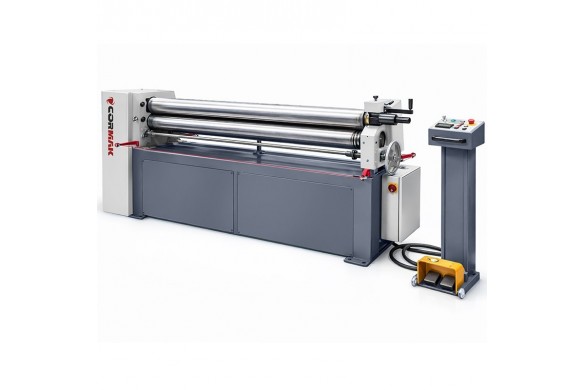
Three-roll or four-roll plate rolling machine – which model should you choose?
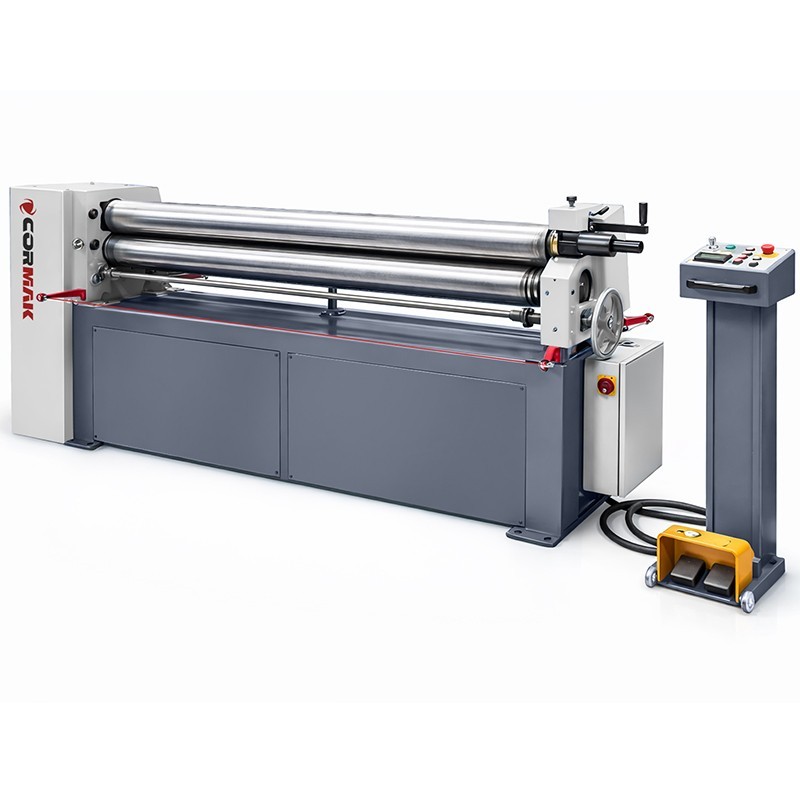
Three-roll or four-roll plate rolling machine – which model should you choose?
A plate rolling machine is used to produce cylinders, arcs, rings, cones, guards and tank components. This type of machine is used in metalworking shops, steel structure production, ventilation, power engineering and industrial equipment manufacturing.
Before purchasing a machine, companies most often compare three-roll and four-roll designs. A four-roll machine can offer a high level of automation in large-scale production. For most workshops and companies handling varied orders, however, a three-roll plate rolling machine is usually the more practical choice.
Its main advantages are simpler construction, versatility, easier operation and a favourable ratio between price and capability. A properly selected machine can handle both single jobs and regular production batches.
How does a three-roll plate rolling machine work?
Plate rolling takes place between three working rolls. The sheet is fed into the machine, and the position of the rolls gives the material the required radius.
Depending on the design, the machine may have a symmetrical or asymmetrical roll arrangement. In symmetrical models, the top roll is positioned between the two lower rolls. Its position determines the pressure applied to the material and the radius obtained.
Rolling is usually carried out in several passes. The operator gradually increases the pressure while checking the shape of the workpiece. This allows the radius to be corrected and reduces the risk of excessive sheet deformation.
Asymmetrical models make it easier to pre-bend the edges before the main rolling process. This reduces the length of straight sections left at the beginning and end of the sheet.
Why choose a three-roll machine?
A three-roll plate rolling machine offers a high degree of flexibility. It can be used for one-off production, short batches and regular rolling of sheets with different thicknesses and widths.
Three-roll machines are used to produce:
- steel pipes and shells,
- ventilation ducts,
- guards and machine housings,
- cylindrical tank sections,
- boiler components,
- arcs and semi-circular profiles,
- cones and structural parts.
A simpler design also means fewer mechanisms requiring adjustment and maintenance. This makes operator training, daily use and service organisation easier.
For small and medium-sized companies, investment cost is also important. A three-roll model offers broad production capabilities without the need to purchase a more complex four-roll machine.
Manual, electric or hydraulic plate rolling machine?
A manual plate rolling machine is suitable for thin sheets, small workpieces and occasional use. It does not require power and has a simple structure, but its output depends on the operator’s force and experience.
An electric drive makes plate rolling easier in short and medium production runs. A constant roll speed helps obtain an even shape and reduces the effort required to guide the material.
Hydraulic three-roll plate rolling machines are designed for thicker sheets and more intensive use. Hydraulic roll adjustment increases pressing force and makes it easier to control parameters during consecutive passes.
How is a four-roll machine different?
In a four-roll machine, an additional roll helps hold the material more firmly during pre-bending and further forming. This can support automation, shorten cycle time and reduce the need to reposition the sheet.
Four-roll machines are mainly used in serial production, where identical components are made regularly and every time saving affects the efficiency of the whole line.
More rolls also mean a more complex structure, a higher purchase cost and more advanced control. In a workshop producing varied parts, the full potential of a four-roll model may not be used.
In such conditions, a three-roll plate rolling machine usually provides greater flexibility and a lower cost for typical jobs.
Can a three-roll model provide sufficient accuracy?
A correctly set three-roll plate rolling machine can produce repeatable radii and an even shape across the full sheet width. The final result depends mainly on roll parallelism, the condition of working surfaces, the material grade and the way the sheet is guided.
Before starting a batch, it is worth making a test piece. After pressure is released, the material may partially return toward its previous shape. This springback effect should be compensated by the correct roll settings.
The number of passes is also important. Gradual rolling gives more control than trying to reach the final radius in a single cycle.
How to choose a three-roll plate rolling machine?
Before buying, determine the maximum width, thickness and strength of the material to be rolled. Roll diameter, the minimum possible diameter of the formed part and the method of pressure adjustment are also important.
The machine should not be selected exactly at the limit of its rated parameters. If the workshop regularly rolls sheets at the maximum thickness specified for a given model, it is worth choosing a larger machine with an appropriate reserve.
For cone production, check the availability of guides or additional equipment. For closed cylinders, the ability to tilt or quickly release the top roll is useful because it makes removing the finished part easier.
Summary
A four-roll plate rolling machine can be a good solution for large, automated serial production. However, it involves a higher cost and more complex operation.
For most workshops and production companies, a three-roll plate rolling machine will be the better choice. It offers high versatility, easier adjustment and the ability to produce cylinders, arcs and cones from different types of sheet metal.
A properly selected plate rolling machine allows companies to achieve high repeatability without unnecessarily increasing the investment cost.
Latest blog postsAll articles →