Planer-Thicknesser vs. Thicknesser – Differences, Operation, and Buying Guide | Blog - CORMAK
Planer-Thicknesser vs. Thicknesser – Differences, Operation, and Buying Guide | Blog - CORMAK
Planer-Thicknesser vs. Thicknesser – Differences, Operation, and Buying Guide
When choosing woodworking machinery, many users wonder whether to buy a planer-thicknesser or a standalone thicknesser. Both machines serve similar purposes but differ in design, functionality, and application. Below we explain how they work, what makes them different, and which one to choose depending on your needs.
1. What’s the difference?
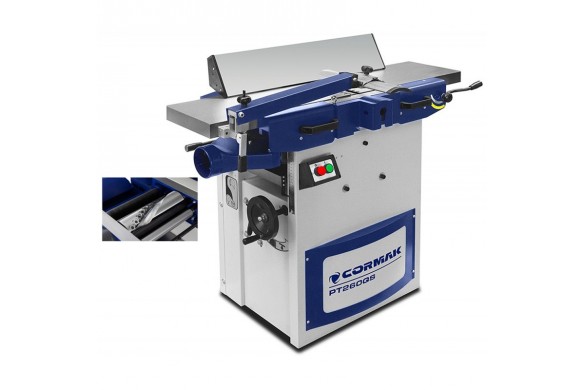
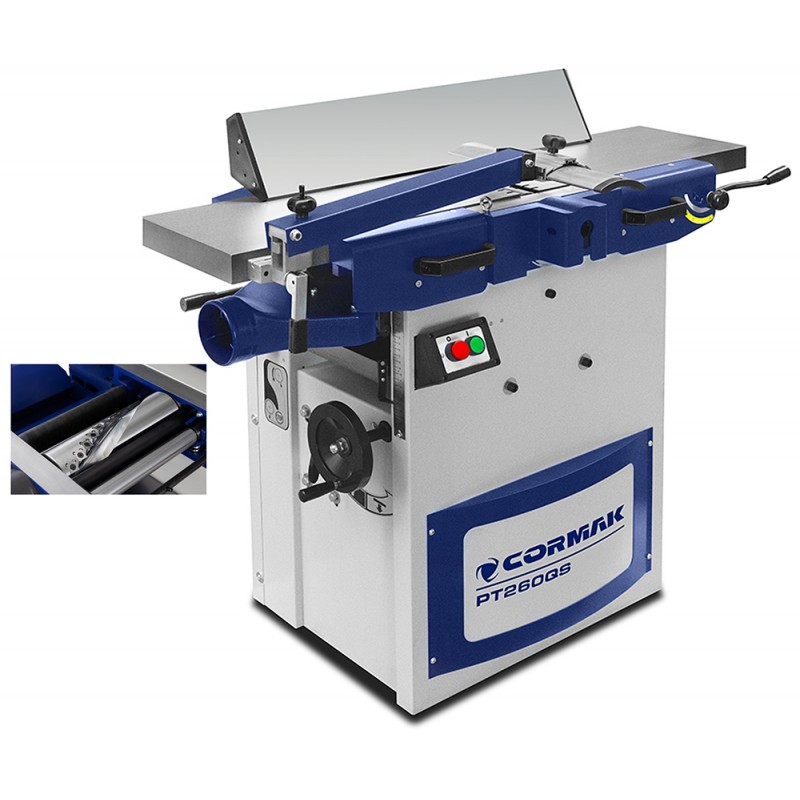
A planer-thicknesser combines two machines in one — a surface planer and a thicknesser. It allows you to flatten one face and then plane the other to an exact thickness.
- Planer (surface planer) — levels one side of the board.
- Thicknesser — makes the opposite face parallel and adjusts the final thickness.
A thicknesser alone only handles thicknessing; it assumes the material is already flat on one side. It’s simpler to use and faster for repeated thicknessing jobs.
2. How they work
Planer-Thicknesser
It has an upper and lower table. The rotating cutterhead removes thin layers of wood as the piece slides across the table. Switching modes allows thicknessing on the lower table.
Thicknesser
The workpiece is fed automatically under the rotating cutterhead by powered rollers, removing material to reach a uniform thickness.
3. Advantages and disadvantages
Planer-Thicknesser – Advantages:
- Two functions in one machine – space and cost savings,
- Complete wood preparation (flattening + thicknessing),
- Perfect for small workshops and home use.
Disadvantages:
- Requires switching modes,
- Slightly longer setup time,
- Higher price than a basic thicknesser.
Thicknesser – Advantages:
- Simpler setup and faster operation,
- More stable for serial work,
- Usually lower cost.
Disadvantages:
- Cannot flatten surfaces – needs a separate planer,
- Less versatile,
- Requires pre-prepared material.
4. Choosing the right machine
- Hobbyists & small workshops: a planer-thicknesser is best – compact and versatile.
- Professional joineries: a standalone thicknesser offers higher capacity and speed.
- Industrial setups: both machines together increase workflow efficiency.
5. What to check before buying
- Motor power – affects performance on hard woods,
- Width & height capacity – match to your largest workpieces,
- Cutterhead type – spiral (HM) gives smoother results and quieter operation,
- Worktable – cast iron for stability,
- Chip extraction – essential for clean and safe work.
6. CORMAK Planer-Thicknessers
CORMAK offers a full range of planer-thicknessers and thicknessers — from compact workshop models to industrial spiral-head versions. Every machine ensures durability, precision, and smooth operation.
Summary
The choice between a planer-thicknesser and a thicknesser depends on your workflow and production scale. A planer-thicknesser is ideal for versatility, while a thicknesser excels in speed and consistency. CORMAK machines guarantee precision, reliability, and professional results in every workshop.
Latest blog postsAll articles →