Laser Cleaning: Pulsed vs CW – What Is the Difference and Which One Should You Choose?
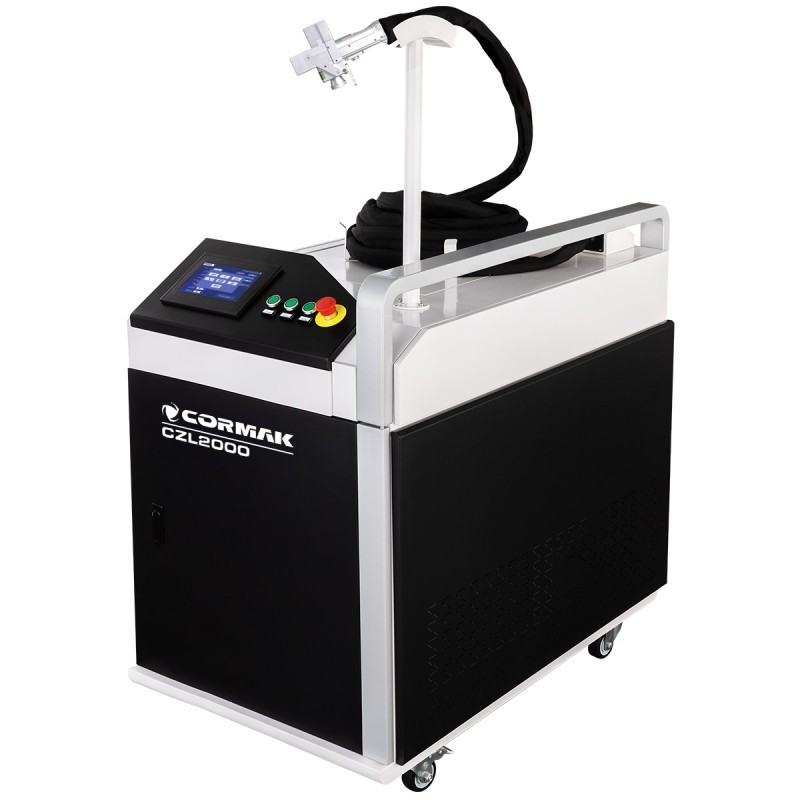
Laser Cleaning: Pulsed vs CW – What Is the Difference and Which One Should You Choose?
Laser cleaning removes rust, coatings, oxides, residues and other contaminants from a surface. The beam interacts primarily with the layer to be removed, making the process contact-free, precise and able to reduce the use of abrasives and chemicals.
The key choice is how energy is emitted: a pulsed laser works in short bursts, while a CW laser delivers a continuous beam. Neither is universally superior. The right option depends on the substrate, contaminant, required finish, production scale and safe workstation design.
How Does Laser Cleaning Work?
The laser head scans the beam across a defined working area. Rust, paint, oxides, oil or production residue absorb energy differently from the substrate. With suitable settings, the unwanted layer can be detached, vaporised or broken down, leaving the surface prepared for welding, painting, bonding or another process.
Performance depends on much more than the laser's rated power. Pulse energy and repetition rate or continuous power, spot size, scan width and speed, working distance, surface state and layer thickness all matter. For that reason, the process should always be validated on a sample that represents the real workpiece.
Pulsed Laser Cleaning
A pulsed laser delivers energy in short, repeated pulses. This allows high peak power over a very short period, while intervals between pulses give the surface time to dissipate part of the heat. In practice, this provides strong control over the removal of thin layers and local energy input.
Typical applications
- precision parts and surfaces where finish quality matters;
- light to medium rust, oxides, weld discoloration and surface residues;
- moulds, tools, fixtures and high-value components;
- stainless steel, aluminium and thin sheet where reduced thermal influence is important;
- selective removal of thin layers from defined zones.
Benefits
Pulsed operation makes it easier to meter energy accurately over a small area. With correctly selected parameters, it can reduce the risk of excessive heating, discoloration or unwanted surface changes. It is therefore often selected when preserving the substrate finish is as important as removing contamination.
Limitations
A pulsed laser is not automatically slower or faster than CW; the result depends on the layer, scan field and settings. However, for extensive heavy coatings or massive structures, a unit focused on fine cleaning may be less practical than a high-throughput CW system. It also requires careful selection of pulse energy, repetition rate and scan mode.
CW Laser Cleaning
A continuous-wave, or CW, laser emits energy without interruption. Its stable beam can deliver high average power to the surface and can be effective on heavier contamination. CW systems are commonly considered where cleaning speed across a larger area is a priority.
Typical applications
- large steel structures, frames, profiles and machine components;
- thicker rust, old paint and difficult industrial deposits;
- surface preparation before welding or coating on more robust parts;
- repetitive industrial work where area throughput matters.
Benefits
A continuous beam can transfer energy rapidly, making CW systems suitable for larger-scale industrial work. With a properly configured head, they can remove layers that would be time-consuming to tackle with manual grinding or scraping.
Limitations
Continuous energy input makes heat management especially important. Excessive power, slow hand movement or an unsuitable working distance can leave thermal marks, discoloration or locally overheat the substrate. CW is therefore not automatically the best option for thin, decorative or heat-sensitive workpieces.
Pulsed vs CW – Key Differences
| Criterion | Pulsed laser | CW laser |
|---|---|---|
| Energy delivery | Short, controlled pulses | Continuous beam |
| Main priority | Precision, selectivity and lower thermal influence | High average power and area throughput |
| Typical use | Oxides, discoloration, light coatings and precision parts | Thicker rust, old paint, large structures and heavy contamination |
| Sensitive workpieces | Often easier to control on thin and valuable parts | Requires careful parameter selection and process trials |
| Important settings | Pulse energy, repetition rate, scan mode and focus | Continuous power, spot size, scan speed and focus |
| Risk when poorly set | Incomplete removal or unwanted surface texture | Excessive heat input and thermal marks |
Do not compare sources by wattage alone. A 100 W pulsed system and a 1000 W CW system deliver energy differently and are not direct equivalents in cleaning performance.
How to Select the Technology
Choose pulsed laser cleaning when:
- surface quality and controllability are the top priorities;
- you clean aluminium, stainless steel, thin sheet, moulds, tools or precision parts;
- you remove oxides, weld discoloration, light rust, residues or thin coatings;
- the part is high value and damage would be costly;
- you need selective cleaning of defined areas.
Consider CW laser cleaning when:
- you clean large, robust steel structures;
- large-area throughput is the main criterion;
- you remove thicker rust, old coatings or strongly bonded contamination;
- the process involves repetitive preparation before further manufacturing.
The safest selection method is a trial on the actual surface. Use the same material, comparable contamination thickness and real surface condition. This reveals cleaning speed, substrate finish, residue behaviour and extraction requirements.
Parameters That Determine the Result
For both technologies, process configuration is decisive. Too little energy may leave contamination behind, while too much can affect the substrate unnecessarily.
- Average power or CW power: determines energy supplied over time.
- Pulse energy and repetition rate: define pulsed-laser interaction and working speed.
- Scan width and pattern: affect coverage and result uniformity.
- Head travel speed: overly slow movement can increase heat input, while excessive speed can leave residue.
- Focus and working distance: determine energy density on the surface.
- Contaminant type: loose rust, paint, oxides, oil and process deposits behave differently.
- Substrate: carbon steel, stainless steel and aluminium differ in thermal conductivity, reflectivity and surface sensitivity.
Common Mistakes and Problems
- Choosing by power only: power does not replace analysis of the layer, part and scan-head settings.
- Skipping process trials: settings from a different machine or material may not provide the same result.
- Moving the head too slowly: can add unnecessary heat and thermal marks.
- Ignoring focus control: incorrect working distance reduces effectiveness and repeatability.
- Omitting extraction: removed layers can create dust, fume or aerosol requiring capture.
- Assuming the substrate cannot be damaged: every process needs sample validation and correct settings.
Safety and Fume Extraction
Laser cleaning requires a workstation designed for the laser class, manufacturer instructions and risk assessment. Handheld systems with an open beam can present serious eye and skin hazards, while interaction with coatings can generate dust, fume and vapours.
- use protective equipment specified for the exact wavelength and laser class;
- define and mark the work area, preventing unauthorised access;
- use local fume extraction selected for the removed material;
- inspect protective windows, optics and safety components regularly;
- provide operator training and clear start-up, stop and storage procedures;
- do not process coatings of unknown composition without a hazard assessment and appropriate extraction strategy.
Safety is part of process quality. Proper extraction and zone control help protect people, keep optics clean and support consistent cleaning results.
FAQ
Is a pulsed laser always better than CW?
No. Pulsed lasers are often preferred for controllable, precise layer removal, while CW systems can be more suitable for large, heavily contaminated surfaces. Choose based on the task and process trials.
Does CW always remove rust faster?
It can be highly productive on large and robust parts, but real speed depends on rust thickness, power, scan field, operating technique and the required cleanliness level. Rated power alone does not define speed.
Is laser cleaning completely waste-free?
No. It often avoids blasting media and many chemicals, but removed rust, paint and residues may become dust, particles and vapours. These must be captured and managed according to the contaminant.
Can aluminium and stainless steel be cleaned?
Yes, but both require careful parameter selection and trials. Pay attention to heat input, surface appearance and any trace left by the process.
Summary
Pulsed and CW laser cleaners serve different, often complementary tasks. Pulsed systems are commonly preferred where precision, selectivity and reduced thermal influence are important. CW systems can be effective where high throughput on large, robust surfaces is the priority.
The right choice is not determined only by source type or wattage. It requires an assessment of the material, contamination, target quality, throughput, safety arrangements and results of representative process trials.
Latest blog postsAll articles →