How Does a Welding Positioner Work?
How Does a Welding Positioner Work?
A welding positioner is a device that helps place a workpiece in a comfortable, stable and safe position for welding. Instead of turning a heavy part by hand, the operator can rotate it around an axis, tilt it to the required angle and keep it securely positioned during the process.
This improves access to the joint, makes torch handling easier and supports process repeatability. Welding positioners are used in workshops, fabrication shops, service departments, maintenance teams and production plants where weld quality, ergonomics and workstation efficiency matter.
What Is a Welding Positioner?
A welding positioner is a device used to rotate, tilt or set a welded component in a position that makes welding easier. It helps place the workpiece where the welder has better visibility, better access and more control over the weld pool.
A positioner does not replace proper material preparation, clamping, welding parameters or operator skill. It is, however, an important part of workstation organisation because it reduces manual handling and helps maintain repeatable working conditions.
What Is a Welding Positioner Used For?
The main purpose of a positioner is to set the workpiece in the most favourable welding position. The operator can rotate, tilt and stabilise the part so that weld execution is easier and more predictable.
Welding positioners are commonly used for:
- pipes, flanges and nozzles;
- tanks, sleeves and cylindrical parts;
- frames, profiles and steel structures;
- machine parts and assembly components;
- parts requiring circumferential welds;
- series production where repeatability is important.
This allows the welder to work more steadily without repeatedly walking around the part or manually repositioning heavy components.
Main Components of a Welding Positioner
The design depends on the model and load capacity, but a typical positioner includes several basic assemblies.
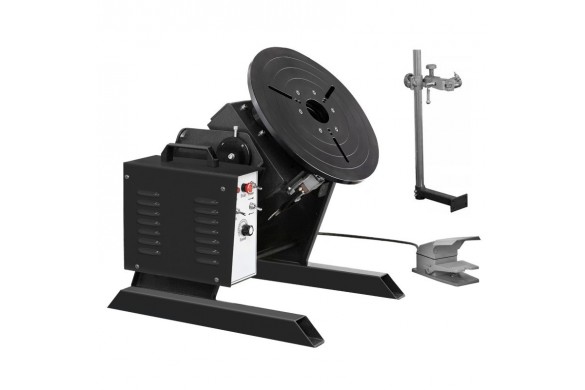
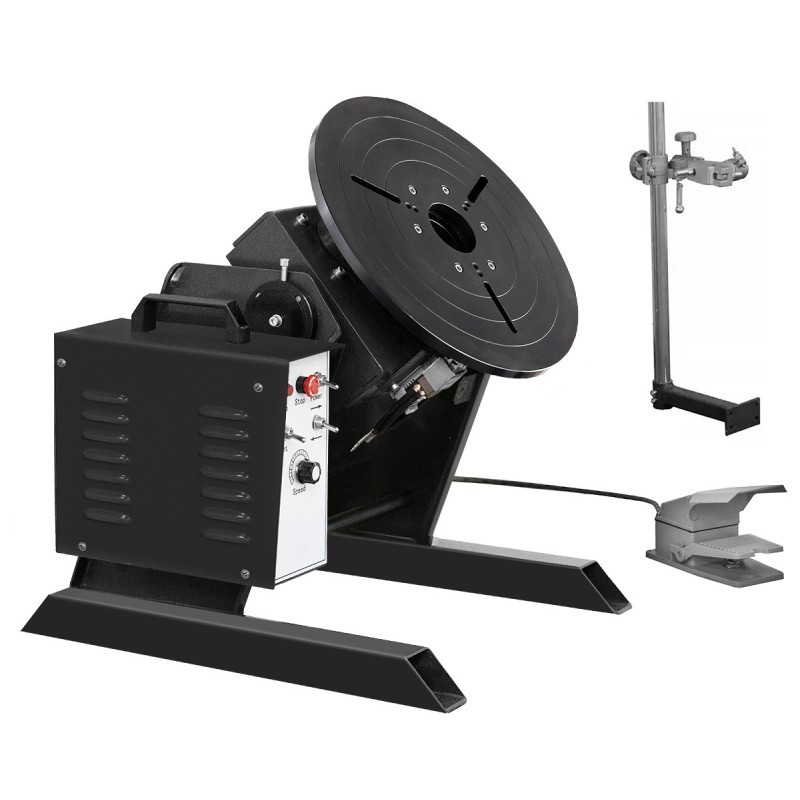
Worktable or mounting plate
This is where the workpiece, fixture or clamping accessory is attached. The table rotates during operation, so it must provide stable support and suitable mounting points.
Drive mechanism
The drive provides rotary motion and maintains the selected speed. Many models offer variable speed control, allowing the operator to match rotation to workpiece diameter, weld type and welding method.
Tilt mechanism
Tilt adjustment makes it possible to place the workpiece in a position that supports easier weld execution. A wider tilt range gives more flexibility for different jobs.
Supporting body
The body provides rigidity and stability. This is especially important for heavier parts, larger overhangs and off-centre loads.
Controls
A positioner may be operated from a panel, knob, foot pedal or external controller. Manual control may be enough for simple work, while series production benefits from smooth speed control and convenient start/stop operation.
Operating Principle
The principle is straightforward: the workpiece is fixed to the table, set at the required angle and then rotated. The positioner keeps the part stable and turns it at a speed matched to the welding process.
For circumferential welds, the welder can keep the torch in one comfortable working zone while the rotating workpiece moves the weld joint in front of the torch. This makes it easier to maintain torch angle, distance and travel speed.
A positioner can be used for manual welding, semi-automatic welding or as part of a simple automated cell. In each case, correct clamping and proper selection for weight, geometry and centre of gravity are essential.
Key Technical Parameters
When selecting a welding positioner, do not look only at maximum load capacity. Workpiece size, clamping method, tilt range and low-speed stability are also important.
- Load capacity – should include the workpiece, fixture and clamping accessories.
- Centre of gravity – a part positioned away from the rotation axis may load the positioner differently than its weight alone suggests.
- Table diameter – affects stable workpiece mounting.
- Tilt range – helps set the workpiece in a convenient working position.
- Rotation speed range – important for circumferential welds and different diameters.
- Control method – panel, potentiometer, foot pedal or integration with other devices.
- Structural stability – important for larger parts and off-centre loads.
- Accessory compatibility – useful for pipes, flanges, sleeves and repeatable parts.
Why Use a Welding Positioner?
The main advantage is better control of the welding process. A stable and evenly rotating workpiece allows the welder to work without constant changes in body position.
Better weld quality
A positioner helps maintain torch angle, travel speed and access to the joint. This may reduce the risk of uneven bead appearance, lack of fusion, excessive reinforcement or rework.
Greater repeatability
In series production, a positioner helps perform successive parts under similar conditions. The operator can repeat angle, clamping and rotation-speed settings more easily.
Improved ergonomics
The welder does not need to work in a forced posture or manually rotate heavy parts. Less fatigue can support steadier movement and better comfort over long working periods.
Higher workstation efficiency
Less manual repositioning means shorter setup time and smoother task execution. In many operations, the positioner reduces interruptions required to change the workpiece position.
How to Select a Positioner
Selection should start with the actual parts and the way they are welded. Prepare a list of commonly welded components, their weight, diameter, dimensions, clamping method and required welding position.
- Determine total weight – include the workpiece and all clamping fixtures.
- Check the centre of gravity – this strongly affects safety and drive loading for asymmetric parts.
- Select table diameter – it should allow secure and repeatable clamping.
- Verify tilt range – the more varied the parts, the more important angle adjustment becomes.
- Check rotation speed – it should match the workpiece diameter and required weld travel speed.
- Evaluate controls – a foot pedal may be useful for manual welding, while series production benefits from smooth, repeatable speed control.
Welding Positioner – Key Elements at a Glance
| Element | Role | What to check |
|---|---|---|
| Worktable | Holds and rotates the workpiece | Diameter, mounting holes, fixture compatibility |
| Drive | Provides rotation and speed stability | Speed range, smooth adjustment, loaded operation |
| Tilt mechanism | Sets the workpiece angle | Adjustment range and position locking |
| Controls | Supports process control | Panel, pedal, direction, speed adjustment |
| Body | Provides rigidity and stability | Weight, structure, resistance to off-centre loads |
Safety When Using a Positioner
A positioner improves safety only when it is correctly selected and used as intended. The workpiece must be securely clamped, and its weight and centre of gravity must stay within the device limits.
- do not exceed the permissible load capacity;
- include the weight of fixtures and accessories;
- check workpiece clamping before starting rotation;
- keep hands away from moving zones during operation;
- protect welding cables from being pulled in or damaged;
- follow safety procedures, use PPE and perform a workstation risk assessment.
Summary
A welding positioner works by securely setting, tilting and rotating a workpiece into a position that makes welding easier. It usually consists of a worktable, drive, body, tilt mechanism, clamping elements and controls.
A properly selected positioner improves access to the weld, supports operator ergonomics, increases repeatability and helps achieve better weld quality. When choosing one, consider not only load capacity but also centre of gravity, clamping method, tilt range, rotation speed and workstation safety requirements.
Latest blog postsAll articles →