

CNC Press Brake Axes – How They Work and What They Do
CNC Press Brake Axes – How They Work and What They Do
CNC Press Brake Axes – How They Work and What They Do
Modern CNC press brakes combine high forming force with outstanding precision. The secret behind their performance lies in the axis system — controlling beam movement, backgauge positioning and real-time compensation. Understanding these functions is key to achieving perfect bending angles and repeatability on CORMAK machines.
Main Axes – Core Motion Control
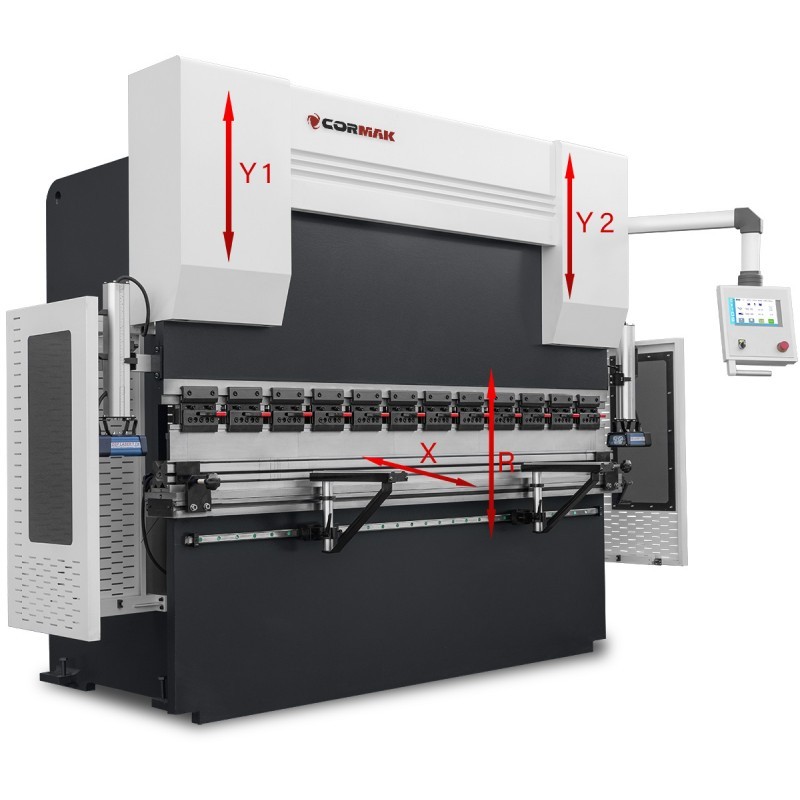
Axes Y1/Y2 – Vertical Cylinder Movement
Every advanced CNC press brake features two independent Y1 and Y2 axes, each controlling one side of the ram. This ensures perfect parallelism with the table even under asymmetric loads or during long part bending.
- Closed-loop feedback with linear encoders guarantees accurate positioning.
- Independent control maintains consistent bending angles across the entire length.
- Real-time synchronization between Y1 and Y2 ensures world-class precision for industries like automotive, aerospace and architecture.
Axis X – Backgauge Positioning
The X axis moves the backgauge forward and backward, defining the flange length. Advanced systems include X1/X2 split control for independent finger movement.
- Servo drives offer precision up to 0.02 mm.
- Automatic positioning reduces setup time and human error.
- Perfect repeatability for every bend.
Backgauge Axes – Flexibility and Control
Axis R – Vertical Finger Adjustment
The R axis raises or lowers the backgauge fingers, ideal for stepped or offset bends. Dual R1/R2 setups allow each finger to move independently for complex parts.
Axis Z – Lateral Finger Movement
The Z axis enables the fingers to move sideways along the machine width. With Z1/Z2 control, each finger can be positioned separately — ideal for multi-tool setups or irregular components.
Advanced Axes – Precision and Compensation
Axis V – Dynamic Crowning Compensation
When bending long or thick sheets, the press bed may deflect under pressure. The V axis automatically compensates by adjusting the bed or ram, maintaining perfect angles across the part.
- Real-time micro-adjustments ensure uniform bends.
- Standard or optional in CORMAK CNC press brakes.
- Essential for high-precision industries working with large panels or high-strength steel.
Axis Delta X – Independent Finger Control
The optional Delta X axis enables independent movement of each backgauge finger along the X axis — ideal for irregular or asymmetric parts. It minimizes setup time and maximizes geometric flexibility.
Automation and Support Axes
Sheet Followers
Servo-driven sheet followers support large and heavy panels during bending, synchronized with the press cycle. They prevent deformation and improve operator safety, especially on tandem or high-tonnage machines.
Robotic Handling
Modern CORMAK bending systems integrate robots for loading, unloading and part handling. Fully synchronized with CNC control, they allow continuous 24/7 production with maximum consistency and efficiency.
Synchronization and Optimization
The CNC controller coordinates every axis in real time using feedback from encoders and sensors. Dynamic synchronization ensures precision, while adaptive control automatically adjusts crowning and backgauge positions.
Summary
In a CNC press brake, Y1/Y2 axes control the ram, X, R and Z axes manage positioning, and the V axis compensates deflection. Optional Delta X and automation further increase flexibility. CORMAK press brakes combine all these technologies in one powerful system – guaranteeing precision, repeatability and productivity for modern manufacturing.
Latest blog postsAll articles →


